
How to create ads people want to buy from


Most brands are doing their advertising wrong.
They put too much focus on who they target and not enough on understanding consumers' motives. They fail to create ads that consumers actually want to buy from.
Understanding the fundamentals of creative strategy provides a competitive advantage in today's ad-saturated market.
What is creative strategy?
Good creative strategy delivers the right message to the right audience, on their preferred platform, at the right time.
This ensures that ads have a higher likelihood of resonating with the intended audience and increases the chances of sales being made or leads being generated.
Creative strategy helps marketers create a better connection with consumers by better understanding their needs and desires and exploring new angles and ideas for testing.
The insights gained from creative strategy can influence various aspects of marketing, from copywriting to landing page development, and even backend retention efforts. With psychology as its foundation, creative strategy stands the test of time, adapting to the constantly changing modes of message delivery.
Why is creative strategy so important?
There are two key reasons why creative strategy is so important right now.
01 Research by Neilsen shows that 56% of all auction outcomes on Meta can be attributed to the creative.
With the creative playing such an important role, it’s incredibly important that it has the ability to cut through and be meaningful and memorable. If the creative isn’t memorable and consumers don’t engage, you’ll be paying higher costs for lower performance in the auction.
If ads are too repetitive and similar to each other, you will find your ads being delivered to the same audience repeatedly. Developing differentiated creatives allows your campaigns to reach new audiences.
Ad fatigue is also a real thing. If an audience sees the same message repeatedly, no matter how relevant it is to them, the message will become diluted and engagement will drop. All creatives decline over time with the window of high performance shrinking all the time. When we’ve created ad iterations we’ve seen significant performance increases compared to older ads.
02 The iOS 14 Update that changed the game.
For years the Facebook Ads platform was a real growth engine that easily allowed businesses to cost-effectively get their brand in front of the target audience that may never have known they existed. But this was made much more difficult in 2021 when Apple launched the infamous iOS 14 update.
Part of iOS 14 was an app tracking transparency measure which meant that users had to actively opt-in to share their data with advertisers, rather than the globally standardised opt-out. As a result, 80% of Facebook’s users on Apple devices decided to opt-out, resulting in 40% of ad impressions not being tracked.
This has caused three major problems for advertisers that continued to use the platform as they did before the update:
- Targeting - With more users opting out of tracking, in-platform audience sizes reduced.
- Optimisation - Reduction of the number of conversion events per website meant fewer data points and less understanding of what consumers who saw an ad did on-site.
- Reporting - A huge proportion of users were no longer tracked. This led to inaccuracies between the sales data reported by Facebook and a brand’s website or CRM.
The result of these changes is that there is a need to focus on broader targeting strategies rather than optimising specific aspects of an ad account to drive profitability. It means building a meaningful connection with your audience is paramount and we now need to actually market properly to consumers.
Alongside the iOS 14 changes Facebook's algorithm has improved, leading to less control over targeting parameters and emphasising the importance of creatives, copywriting and marketing psychology. This shift placed creative strategy at the forefront of campaign success and it has become one of the most significant levers to scale and optimise ad accounts successfully.
Leveraging consumer psychology
Creative strategy is underpinned by psychology and human behaviour. To run successful ads, we need to learn psychology and understand how to apply it to our ads to drive sales.
Consumer psychology is the study of how consumers make decisions and choices related to purchasing products and services. It looks at the various psychological, emotional, cognitive, and social factors that influence consumer behaviour in the marketplace. It considers how consumers make decisions, what will motivate them to buy and how and why they assess value. Understanding consumer psychology is essential for advertisers and will help you to design more effective ads to attract and persuade potential customers.

Rational VS. Irrational decision making
Consumers make both rational and irrational decisions. When making a rational decision, the consumer is objective and will come to a decision based on logic and reason. Advertising to these people is pretty straightforward.
When making an irrational decision, the consumer isn’t making decisions on sound reason or judgement and will use emotion to guide the decision. Advertising to these people in a rational way won’t work.
The same product can be purchased both rationally and irrationally but the triggers to purchase will be different.
Let's take the example of buying a mobile phone. The rational decision maker will look at the features of the phone and check to see if they align with their needs.
If the consumer likes using their phone to take photos at night, they’ll check out the details and look for comparison examples of photos on this phone against others. If it meets their needs, then they will make the logical decision that this product is right for them.
The irrational decision maker however will be buying with emotion and will most likely see the latest phone as a status symbol that gives them peer credibility. They’re less concerned with what the phone can do and more concerned about what having the phone says about them.
Utilising the nine consumer mindstates
There are nine fundamental motivators present in every consumer identified by Will Leach in the book Marketing to Mindstates. These motivators serve as the driving forces behind consumer behaviour and decision-making processes.
Belonging/Acceptance
- Consumers are motivated to seek approval and camaraderie by identifying commonalities that foster a sense of belonging.
- They gravitate toward products and services that give a feeling of acceptance and belonging to a tribe or a community of like-minded individuals.
- Messages that promote clarity, togetherness, and community resonate most effectively with this group.
Esteem
- Consumers are seeking esteem, desire and recognition, both in terms of their achievements and physical appearance.
- They aspire to feel respected and seek tools and resources that elevate their social admiration.
- Messages focusing on future attention resonate most effectively with this group.
Nurturance
- Consumers seeking nurturance are motivated by the desire to care for and support themselves and their family and friends.
- Their drive stems from the need to find a sense of appreciation by offering care and support to others and themselves.
- Messages emphasising comfort and care resonate most effectively with this group.
Freedom
- Consumers motivated by freedom love their independence and the ability to make their own choices.
- They actively seek tools and resources that allow them to customise products or experiences on their own terms.
- Messages that promote carefree, worry-free, and adventure-oriented experiences resonate most effectively with this group.
Competence
- Consumers looking for competence want to feel qualified and prepared for the task at hand.They often feel ill-equipped and out of their depth.
- They seek the ability, knowledge and skill to maximise their ability and exceed their expectations.
- They respond best to messages of intelligence, speed of information, and quality.
Security
- Consumers motivated by security desire a sense of safety, protection, and reassurance in their decision-making process. They want to minimise the risk of failure with their purchase.
- They actively seek products that offer protection from physical or emotional harm, providing a feeling of safety.
- Messages emphasising clarity, consistency, and ease resonate most effectively with this group.
Achievement
- Consumers driven by achievement desire to attain success and reach their goals. They may feel incomplete or inadequate without achieving their objectives.
- They actively seek tools and resources that can aid them in achieving their aspirations.
- Messages that assist them in maximising their productivity and showcase accomplishment resonate most effectively with this group.
Empowerment
- Consumers motivated by empowerment seek authority over themselves and desire confidence in their abilities. They may feel oppressed or disadvantaged without a sense of empowerment.
- Their drive stems from the aspiration to feel empowered by expanding their options and level of control in pursuit of their goals.
- Messages should demonstrate to customers what they can achieve and accomplish.
Experience
- Consumers driven by experience desire unique and gratifying life experiences. They may feel dissatisfied with their current options and seek out better experiences.
- They look for brands that can provide a sense of relief and an escape from the world. Their motivation lies in making the most out of the product, service, or experience they choose.
- Messages that highlight satisfaction, enjoyment, and enlightenment resonate most effectively with this group.
The nine pillars of creative strategy
The purpose of strategy is to provide a way to overcome a key challenge. Creative strategy is no different. As with any good strategy you need a framework to create a foundation for success.
The nine pillars of creative strategy, pioneered by Nicole Crowell, cover the whole journey to ensure that rather than simply developing more and more creative in the hope that something sticks, we have a recognition of the challenges that we face and a clear and coherent approach for what we need to do.
So what are these nine pillars and why are they important?
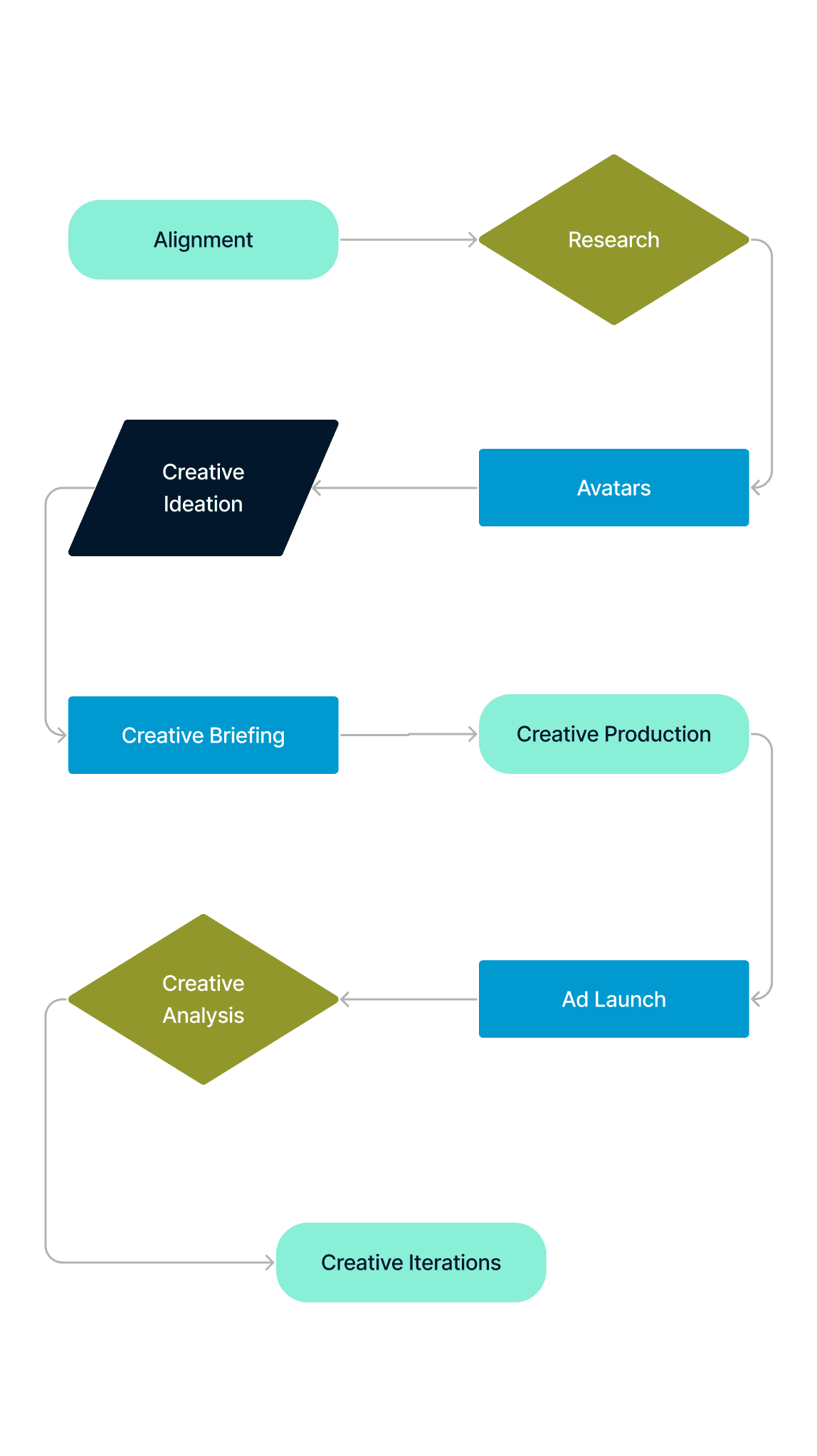
ALIGNMENT
Before any brainstorming and ideation can commence, aligning teams is paramount. It’s vital that everyone understands the brand, to start the process of a more focused and effective creative strategy. This stage should encompass a solid foundation of brand discovery questions to allow the whole team to quickly understand the proposition of the brand better and identify areas where each party will need to be involved and collaborate.
Effective alignment not only involves creative aspects but extends to the entire customer journey. From ads and landing pages to post-conversion follow-ups, every step should be aligned with the brand's message and values. This approach creates a seamless and immersive experience for the audience, helping to build brand loyalty and trust.
A lack of proper onboarding will hinder the ability of the team to create a cohesive and effective strategy, so if you don’t get this bit right the whole strategy could fall down.
RESEARCH
Building ads based on thorough research and data rather than intuition enhances your chances of creating campaigns that work.
By using both internal and external research, you'll be better equipped to understand your audience's needs and preferences as well as gaining insights from competitors' successful strategies.
The starting point for a lot of research is tools such as Meta’s Ad Library. Whilst this is a great tool, solely using this for competitor research provides a narrow view of activity in the market as it only covers ads live in their account at that point and doesn’t factor in ads that may be whitelisted through a third party. Spy tools are available which provide wider context and really help to understand what ads your competitors are running and the messaging they are using.
Studying customer reviews of your own brand and competitors will also help to identify the pain points of the customer and unique selling points that give you an advantage over competitors.
AVATARS
Avatars play a pivotal role in creative strategy, serving as detailed personas that embody your target audience. By personifying your ideal customers, avatars humanise data and provide a relatable touchpoint to help craft compelling ads. They encapsulate demographics, psychographics, behaviours, pain points, and desires, giving a comprehensive view of your audience's mindset.
Avatars serve as navigational tools, guiding decisions throughout the creative process, from ideation to content production. With avatars at the centre, creative strategy becomes focused, ensuring messages resonate authentically with the real people behind the data, ultimately driving higher engagement and conversions.
CREATIVE IDEATION
Ideation is the creative preparation stage before launching ads are developed. It involves brainstorming with your team to focus on generating entirely new ideas and angles for your campaigns. This is where we want to look at new concepts rather than tweaking existing ones.
The ultimate aim of ideation is to produce a large number of new and diverse ideas. Remember no idea is a bad idea and often it’s the craziest, it’ll never get signed off ideas thrown off the top of someone’s head that deliver the big winners.
CREATIVE BRIEFING
A crucial aspect of creative strategy is briefing the team responsible for content production. All too often ads fail due to a lack of briefing to the content creators, often driven by a lack of understanding of what the ad needs to communicate to the target audience. If the research phase has been done effectively, the briefing will be easy.
At its core, the creative brief serves as a means to communicate essential information required for generating new and impactful content. It should strike a balance between simplicity and comprehensiveness, facilitating a clear understanding of the content's purpose and target audience. By supporting content decision-making, the creative brief becomes the guiding framework for content creators, aligning their efforts with the overall campaign objectives.
A common issue with campaigns is that only one set of creative is developed, which doesn’t provide any flexibility for any testing to drive better performance. Ensure that the briefing includes different ad variables and variations to allow for this to happen.
CREATIVE PRODUCTION
The process of content production involves shooting, developing, and editing various creative assets, including graphics, carousels, videos, GIFs, and more. Skilled management of user-generated content and talent sourcing contributes to polished and impactful content.
In this stage, we witness the transition from the creative strategist's efforts to the capable hands of the content production team. Here, the creative strategy brief comes to life, and winning ad creative assets are meticulously crafted. While the creative service continues to support the process, it is crucial for content production to take the lead in sourcing talent, producing content, and ensuring quality control.
AD LAUNCH
You’ve completed all the hard work and you’re now ready to pass the creative assets over to the media buyer to launch in your campaign. Before doing so, clear KPIs and benchmarks should be established to be able to measure success. This will help as you analyse and optimise ad performance.
You don’t want to launch all your ad variations at once. Organise your launch into creative sprints, where all variables and variations to be tested are clearly defined. Each sprint should focus on specific insights and learning objectives. This structured approach enhances the effectiveness of your tests and allows for better analysis.
CREATIVE ANALYSIS AND REPORTING
Creative analysis delves into individual content pieces, scrutinising key performance metrics to uncover insights and opportunities for improvement. This information empowers marketers to optimise campaigns and identify areas for improvements with the ads to ultimately achieve better results.
With data, it’s easy to be overwhelmed and look at too many metrics or focus too much on one hero metric. Both of these will lead to unclear and ineffective analysis. Look at the metrics that matter and can be put together to provide a clear narrative on how users engage with the ad.
ITERATIONS
An iteration is the process of repeating specific steps or actions to achieve incremental improvements or changes. However, it's essential to note that iterations should not alter the overarching ad concept or angle. This can become a new concept altogether.
Iterations are particularly valuable in situations where you seek improvement but lack all the answers or the best approach from the start. Each iteration should build on the previous one, incorporating feedback and data to make adjustments and improvements.
Connect with consumers
In a world crowded with ads, the rules of advertising have shifted. It's not enough to target; it's about connecting. Enter creative strategy and consumer psychology—the dynamic duo that unlocks ads consumers actually want to buy from.
Creative strategy is more than a message; it's a tailored experience. By understanding what resonates with audiences and delivering it at the right time, brands engage and convert. This strategy goes beyond sales; it builds lasting loyalty. Consumer psychology adds the secret sauce. Knowing how rational and emotional decisions shape purchases, brands can craft messages that resonate on multiple levels.
Amid changing privacy norms and algorithm shifts, creative strategy and consumer psychology stand strong. They're not just tools; they're the keys to cutting through the noise, captivating attention, and inspiring action. Brands take note: these insights lead to ads that consumers don't just notice, but actively want to buy from.
Stopped growing online?
We know how to fix that.
We start with your data, not your channels.
Commercial, market, performance, customer and behavioural data, woven into one view rather than five separate reports.
It shows where your profit comes from, which activities earn their place, which are dead weight, and what's worth doing next.
We typically find 15-30% in wasted marketing spend in the first 3 months.
Channels are the tools; making your business more money is the objective.
Latest News
See all
5 Conversion Blockers That Hurt Black Friday Sales
Shoppers are ready to buy this season, but site blockers can send them to competitors. Discover 5 mistakes to avoid and how to fix them.


5 Strategies to Boost Ecommerce Landing Page Conversions
Your ecommerce landing page is critical in the success of your online store. Join 43 Clicks North as we share our tips on boosting your conversion rates.

How building/nurturing communities can benefit your brand
One of the most enigmatic marketing strategies, has always been communities. Find out how building & nurturing communities can benefit your brand with 43CN.