
Why CPL Spikes on Meta Ads and How to Stabilise Them


CPL spikes on Meta are the output of an adaptive auction system reacting to instability inside your account. The platform continuously predicts the probability that a specific impression will lead to a defined outcome. Cost per lead rises when that prediction engine loses confidence, receives distorted signals, or faces stronger competitive pressure for the same users.
Most e-commerce companies or B2C lead gen marketers respond by cutting their budgets, adjusting their bids, and pausing their ads. These change inputs without correcting the structural disturbance that triggered the spike.
At a structural level, CPL inflation generally stems from three mechanisms:
- Delivery instability that forces the system to revert to exploration.
- Corrupted optimisation signals that weaken predictive accuracy.
- Competitive displacement caused by creative fatigue or stronger competing ads.
Each mechanism changes how the auction prices impressions. Without identifying which one is active, the intervention remains reactive instead of corrective.
Stabilise Delivery Structure to Prevent Auction Re-Entry Shock
Meta’s delivery system becomes more efficient as it accumulates conversion data. Each conversion strengthens the model’s ability to predict which users are most likely to become leads.
Frequent structural changes weaken those predictions. The delivery system expands into broader auctions to reassess where conversions may occur. That exploration phase makes impressions reach users with a weaker predicted conversion probability, and CPL rises until the system rebuilds reliable performance signals.
You can stabilise it through a consistent campaign structure. Once delivery stabilises, performance typically follows a pattern like this:
The guide below walks you through how you can apply this approach, with examples that make the process easier to understand.
How to Avoid Campaign Resets That Increase CPL
Step 1: Use Fewer Campaigns With Stronger Budgets
Running too many small campaigns spreads your conversion data across multiple campaigns. Each campaign then has too little data for Meta to learn which users are most likely to convert.
A simpler structure works better. Fewer campaigns with larger budgets allow more conversions to accumulate in the same place, which helps the algorithm learn faster and stabilise delivery.
For Example:
A Shopify store running 10 prospecting campaigns with £10–£15 daily budgets may struggle to generate enough weekly conversions in each campaign. None of them gathers enough data for stable optimisation.
If that budget is consolidated into 2–3 campaigns with £50+ daily budgets, each campaign collects more conversions.
A stable campaign structure usually looks like this:
- One clear objective per campaign
- Broader audiences instead of many small segments
- Consistent budgets
This gives Meta more usable data and prevents signals from being scattered across too many campaigns.
Step 2: Increase Your Ad Budget Gradually
Large budget increases force Meta to quickly find more impressions. This expansion often leads to a temporary increase in CPL. You need to increase budgets 10–20% at a time, then allow several days for delivery to stabilise before making another adjustment.
Example:
- Day 1: £50 daily budget
- Day 4–5: increase to £60
- Day 8–9: increase to £72
This gives the algorithm time to test new impressions without losing the performance signals it has already built.
Step 3: Scale Within Existing Structures Instead of Duplicating
Duplicating a winning campaign might seem like a safe way to scale, but the copy doesn’t inherit optimisation memory. It starts fresh, meaning it enters the learning phase independently of the original.
For example, instead of cloning a high-performing campaign for a flash sale, increase the budget in the original and test new creative variations within that framework. This preserves accumulated conversion history and lets new creatives benefit from the existing delivery model’s learned patterns.
Over time, this continuity helps Meta understand which users convert most often, keeping delivery efficient and costs more stable as spending increases.
Campaign Changes That Reset Delivery Optimisation
Below are three common behaviours that quietly push campaigns back into expensive rediscovery mode.
1. Over-Segmenting Audiences
Complex campaign structures spread conversion data across too many ad sets. Each structure then receives only a small number of conversions, which weakens the algorithm’s ability to learn.
For example, ten ad sets producing three conversions each per week create fragmented signals. One ad set producing thirty conversions provides far stronger data for optimisation.
Each ad set competes for delivery and optimisation resources. If conversion volume per structure is low, the system struggles to identify clear patterns, so delivery stays broader for longer.
In lead generation accounts, this often appears as:
- narrow age splits
- small interest clusters
- multiple lookalike audiences with minimal differences
These splits are usually created to increase targeting precision. In practice, they often dilute the signal strength that the algorithm needs to optimise effectively.
2. Frequently Editing Ads Inside Active Ad Sets
Changes such as replacing creatives, adjusting targeting, or modifying optimisation settings signal to Meta can interrupt delivery stability.
For example, if ads are replaced every one or two days in an attempt to “force performance,” the algorithm never gathers enough conversion data from any single creative to learn which users respond best.
3. Mixing Different Conversion Intent in One Campaign
Campaigns sometimes combine audiences with very different intent levels. Cold prospecting audiences, retargeting audiences, and high-intent users may all sit inside the same campaign or ad set.
Each of these groups behaves differently. Cold audiences require more impressions before converting, while retargeting audiences often convert faster.
When these signals mix, it becomes harder for the algorithm to identify which delivery patterns produce the best results. Separating these campaigns produces clearer conversion signals and more stable delivery patterns.
Having a consistent campaign can collect conversions without disruption, making it easier for Meta to recognise which users convert most often and concentrate delivery in those auctions. Avoid these common mistakes to help stabilise delivery and reduce sudden CPL spikes.
Eliminate Signal Corruption in the Optimisation Loop
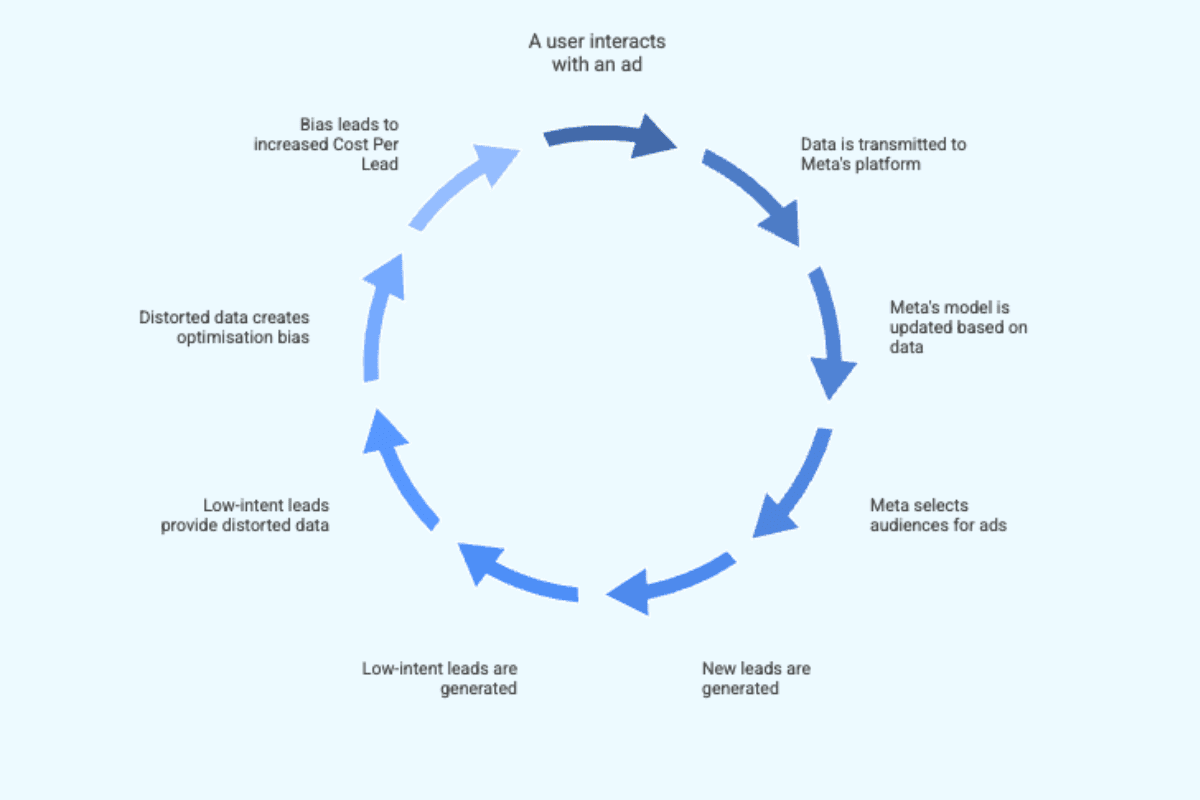
Meta does not optimise for revenue, profit margin, or lead quality unless those outcomes are sent back into the system. The platform only learns from the conversion event you select. Each completed event tells the algorithm what success looks like. The system updates its predictions and starts showing ads to users who behave like previous converters.
If the chosen event reflects weak buying intent, the system still treats it as a success. This issue appears most often in lead generation campaigns, where form submissions are treated as the primary optimisation signal. But the same pattern can also occur in e-commerce when campaigns optimise for shallow behaviour such as Add to Cart (explanations below).
The algorithm begins by prioritising users who are more likely to complete these easy actions. It will become saturated, leading to an increase in auction pressure, and CPL begins to rise. This creates optimisation bias.
The problem sits inside the feedback loop. When the signal does not represent real buying intent, the algorithm keeps reinforcing the wrong pattern. Over time, delivery shifts toward users who complete easy actions rather than users who are likely to buy.
Because the algorithm learns directly from these signals, correcting the feedback loop requires strengthening the event that trains the model.
How to Strengthen the Signals That Train the Optimisation System
Step 1: Optimise Towards a Deeper Event
Raw form submissions often represent weak intent. In many accounts, fewer than 20–30% of submitted leads become sales-qualified. Optimise for a deeper event so the system learns from stronger buying behaviour. For example:
B2C lead generation
- Form Submit → Booked Consultation
- Instant Lead → Verified Email Lead
- Lead → Sales Qualified Lead (SQL) returned from CRM
A home renovation company running lead ads may receive hundreds of form submissions, but only a small portion converts into consultations. If the campaign optimises for Booked Consultation instead of Lead Submit, the system learns from users who schedule a call rather than users who only submit a form.
To optimise, track the consultation booking as a conversion event and send it to Meta through the Pixel, Conversions API, or your CRM. This event should fire when a user successfully schedules a call or reaches a booking confirmation page.
Then select Booked Consultation as the optimisation event in Ads Manager instead of Lead Submit. The algorithm will start learning from users and helps delivery prioritise audiences more likely to engage with the sales team.
E-commerce
Many e-commerce advertisers optimise for Add to Cart because the event volume is high. However, this behaviour often reflects browsing rather than real purchase intent. It needs optimisation to signal a clearer buying commitment.
For example, a skincare brand selling £80 bundles may optimise for purchases above £70 order value using a custom conversion. Instead of treating every purchase as equal, the system learns from higher-value transactions and begins prioritising users more likely to complete larger orders.
Optimising deeper in the funnel reduces event volume. The system still needs enough signals to learn meaningful patterns.
A practical benchmark is 30–50 high-quality events per week per campaign, which gives the model enough data to recognise meaningful patterns.
Step 2: Introduce Strategic Form Friction
Lead forms that take only a few seconds to complete often attract low-intent submissions. Introduce one or two qualification steps so the form reflects genuine buying intent.
Start with small but meaningful filters. Require a business email instead of free email providers, add a budget range field, or include a purchase timeline question. Another effective adjustment is a two-step form, where the first step captures basic details and the second step asks one qualification question before submission.
These additions discourage casual enquiries and encourage more intentional submissions, which strengthens the signal the algorithm receives.
Step 3: Improve Event Reliability Through Accurate Tracking
Start with a quick diagnostic inside Meta Events Manager. Check the Event Match Quality score for your key conversion events. Scores below 6/10 usually indicate that the platform is receiving limited user data, which weakens audience matching and optimisation accuracy.
Strengthen event reliability through a few practical fixes:
- Install both Meta Pixel and Conversions API so conversions are tracked from the browser and the server.
- Send customer identifiers with each event, including hashed email, phone number, and external ID.
- Deduplicate events properly so Meta recognises when the same conversion is sent through both browser and server tracking.
- Return qualified events from your CRM, such as booked calls or sales-qualified leads, within 24–48 hours so the system receives timely feedback.
Signal quality depends on accuracy and consistency, not event volume. Once the optimisation loop receives reliable signals tied to real buying behaviour, delivery becomes more precise, and pricing pressure begins to stabilise.
How Weak Signals Train the System in the Wrong Direction
Below are three common ways advertisers unintentionally weaken those signals.
1. Prioritising Cheapest Leads Instead of Qualified Leads
Focusing on the lowest-cost leads may increase volume and make dashboards appear efficient, but many of these leads rarely become paying customers.
This often occurs in lead funnels tied to e-commerce activity, such as webinar registrations or discount sign-ups. To maintain lead volume, the system expands into broader auctions. Competition increases, and overall CPL begins to rise.
Cheap leads rarely mean efficient acquisition. In many cases, they signal that the optimisation event is too shallow.
2. Optimising for the Wrong Event
The algorithm optimises for the event you select. When that event does not represent real buying intent, campaigns optimise around the wrong behaviour.
For example, campaigns sometimes optimise for:
- link clicks
- landing page views
- form opens
These actions are easy to generate, and your ad performance may appear strong. But the problem appears later when those actions fail to convert into revenue. High activity in Ads Manager does not translate into real sales.
3. Weak or Incomplete Conversion Tracking
When tracking is incomplete or inconsistent, the signals used for optimisation become weaker. This often happens when only browser tracking is used, when Conversions API is not set up correctly, or when events are duplicated or missing identifiers such as email or phone number.
If Meta cannot reliably connect conversions to the people who generated them, audience matching becomes less accurate. Delivery expands into broader auctions to find new patterns. This will eventually increase both impression costs and CPL.
Reduce Competitive Creative Fragility
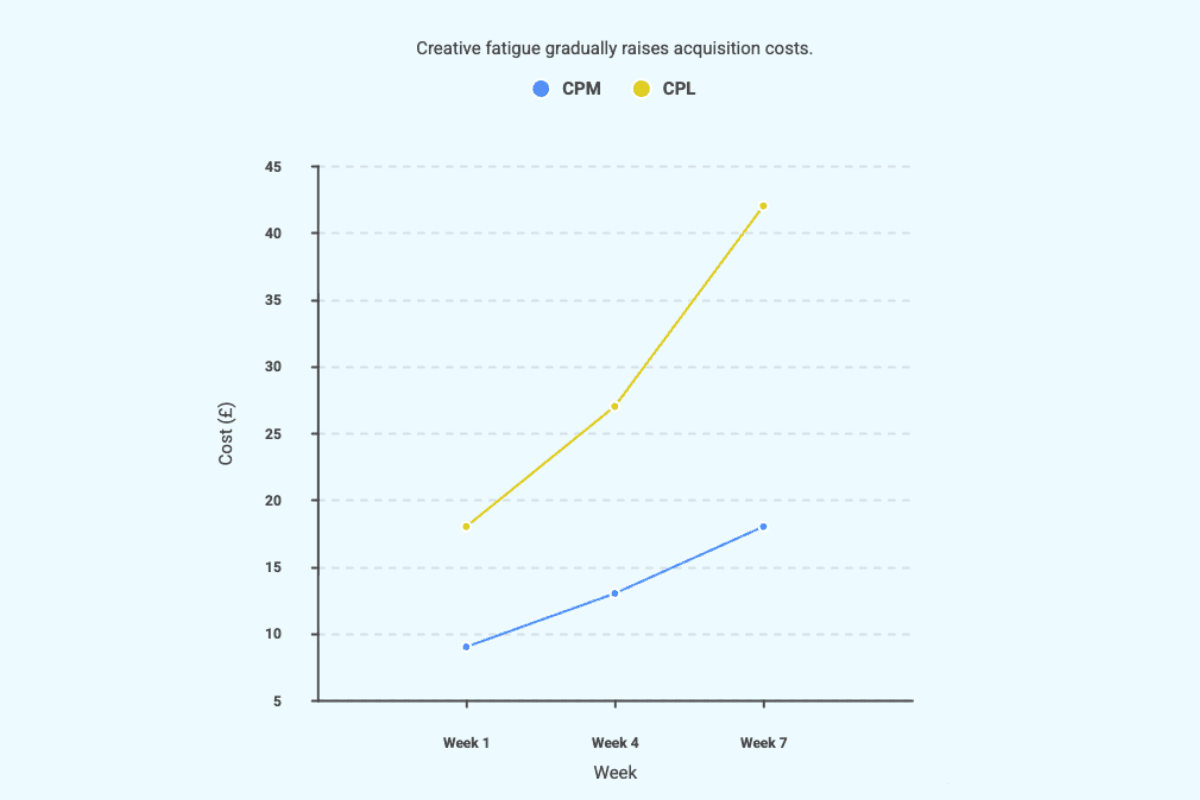
Creative fragility appears if most conversions come from one dominant ad. In e-commerce, a great example would be when a UGC ad performs strongly and receives most of the delivery share. The performance will look like this graph:
In the early stage of delivery, engagement tends to be strong, and costs remain relatively low. As the same creative continues to run for several weeks, the audience encounters it more frequently. Engagement begins to soften, which weakens the ad’s competitive position in the auction. This progression shows how this gradual shift can lead to higher CPM and acquisition costs even though the campaign structure itself remains unchanged.
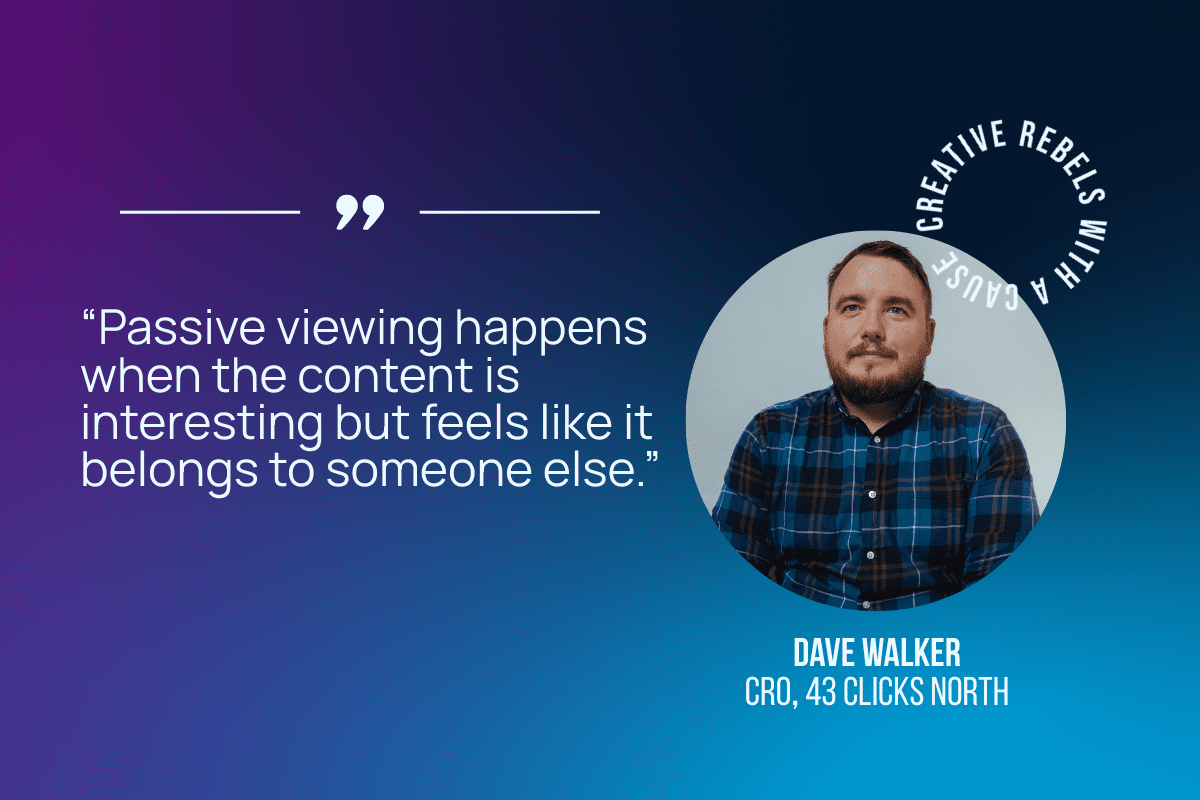
An ad can still look visually strong and communicate the product clearly. But if viewers no longer feel connected to the message, they engage less often. As engagement declines, Meta predicts a lower probability of action and reduces the ad’s competitiveness in the auction.
To avoid this situation, your account needs more than one strong creative. A steady mix of new ads helps distribute performance signals and prevents delivery from relying on a single asset.
How to Strengthen Creative Depth in Your Campaigns
Step 1: Keep Several Creatives Driving Conversions
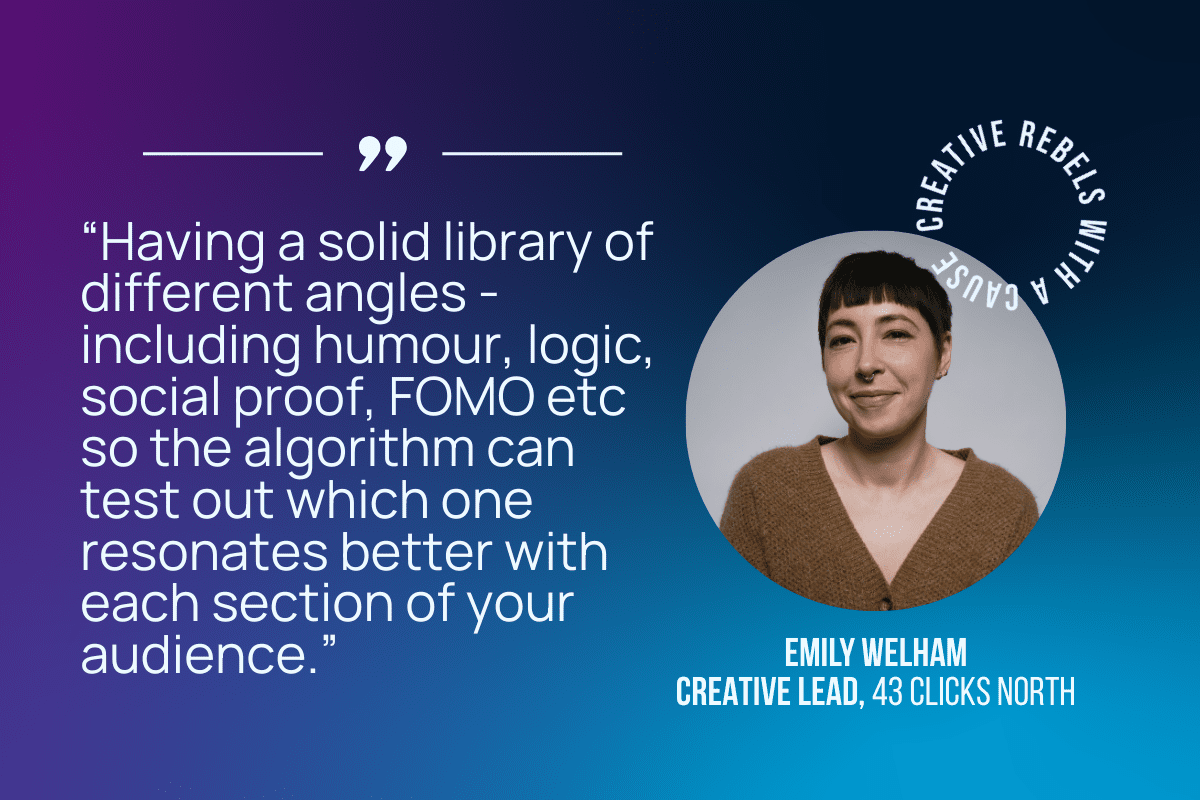
Aim to keep 3–5 active creatives that generate meaningful conversions. Each ad should carry part of the performance instead of relying on one winner. Our creative strategist Emily explains this principle:
For example, a brand selling ergonomic office chairs can apply these several angles:
- UGC testimonial: a customer explaining how the chair reduced back pain during long workdays
- Product demonstration: a short clip showing adjustable lumbar support and seat tilt
- Offer-driven ad: a limited-time discount for remote workers upgrading their home office
- Objection-handling creative: addressing common concerns such as assembly time or price
- Lifestyle framing: a clean home office setup showing the chair as part of a productive workspace
Strong accounts rely on multiple performers working together, not one creative carrying the campaign.
Step 2: Refresh Variations Within Winning Angles
Creative fatigue usually appears first in a falling click-through rate. Extend the life of angles that already resonate with your audience instead of replacing the concept entirely.
If a testimonial works well, try variations such as:
- A new hook in the first three seconds
- A different creator telling the same story
- Stronger problem framing before the solution
- Shorter edits for feeds and longer cuts for reels
Small structural changes can keep an ad effective for several more weeks. A new opening hook alone can often restore engagement without disrupting the optimisation signals the system has already learned.
Step 3: Monitor Creative Concentration Early
Watch for signs that performance is becoming too concentrated in one ad. Three simple indicators help identify this early:
- Share of conversions from the top creative
- Frequency
- CTR trend compared with its peak
If one ad begins producing more than half of the total conversions, start preparing additional variations. Many advertisers allocate 15–25% of their spend for creative testing so new ads are ready before performance weakens.
How You Accidentally Create Creative Concentration Risk
Creative fragility usually forms through small decisions that seem reasonable in the moment but slowly concentrate delivery into a narrow set of creatives.
1. Repeating the Same Opening Hook Across Ads
Many accounts launch several creatives that look different but start with the same opening hook. The visuals, editing, or captions may change, but the first few seconds introduce the same idea.
For example, several ads may open with the line:
“Stop wasting money on uncomfortable office chairs.”
Even though the ads are technically different, they compete with the same entry message. Once that hook becomes familiar to the audience, the entire group of creatives loses impact at the same time.
Using different opening hooks allows the campaign to capture attention from users who respond to different triggers, which spreads engagement across more creatives.
2. Relying on the Same Creator Across UGC Ads
UGC campaigns often build around one creator who performs well early in testing. Brands then produce several variations featuring the same person delivering similar testimonials.
Although the edits may differ, the tone, delivery style, and storytelling remain closely aligned. As a result, multiple creatives behave like variations of a single ad.
Introducing different creators changes the voice, pacing, and delivery style of the message. This helps the campaign maintain creative diversity instead of concentrating engagement around one personality.
3. Framing the Product Around One Problem
Some campaigns build every creative around the same pain point because it resonates strongly with early buyers. For example, an office chair campaign may focus almost entirely on back pain relief. That message can perform well initially, but it limits the range of motivations the campaign speaks to.
Other audiences may respond to different angles, such as posture improvement, workspace aesthetics, productivity during long workdays, or comfort during remote work. Testing multiple problem angles will help spread performance across different creatives.
If you recognise these patterns in your account, take a step back before producing more versions of the same idea. Start expanding the range of hooks, creators, and problem angles so your campaigns rely on several strong creatives.
This type of creative planning requires consistent testing and structured experimentation. If managing that process internally becomes difficult, it may help to work with a team experienced in Meta ad strategy and creative testing.
Build a Meta Ads System That Keeps CPL Stable!
At 43 Clicks North, we help e-commerce and B2C lead generation brands fix the structure of their Meta ad accounts so the platform can learn from clear and reliable data.
- Campaign structures that keep conversion data in one place so the algorithm can learn faster
- Conversion tracking that sends stronger buying signals back to Meta instead of shallow actions
- Creative systems that prevent one ad from carrying all the results
- Budget scaling that increases spend without forcing the campaign back into the learning phase
If your Meta account feels unpredictable or hard to scale, it may be time to rebuild the system behind it. Reach out, and let’s design it properly!
Stopped growing online?
We know how to fix that.
We start with your data, not your channels.
Commercial, market, performance, customer and behavioural data, woven into one view rather than five separate reports.
It shows where your profit comes from, which activities earn their place, which are dead weight, and what's worth doing next.
We typically find 15-30% in wasted marketing spend in the first 3 months.
Channels are the tools; making your business more money is the objective.
Latest News
See all
5 Conversion Blockers That Hurt Black Friday Sales
Shoppers are ready to buy this season, but site blockers can send them to competitors. Discover 5 mistakes to avoid and how to fix them.


5 Strategies to Boost Ecommerce Landing Page Conversions
Your ecommerce landing page is critical in the success of your online store. Join 43 Clicks North as we share our tips on boosting your conversion rates.

How building/nurturing communities can benefit your brand
One of the most enigmatic marketing strategies, has always been communities. Find out how building & nurturing communities can benefit your brand with 43CN.