
What Happens When One Creative Carries Your Meta Ad Account


If one ad is generating 70–80% of your revenue, your account can look strong on the surface. ROAS is healthy. Volume feels consistent. Scaling the budget even works at first.
But your growth is resting on one idea. Meta is learning one dominant buying reason and pushing delivery into the same behavioural pocket again and again. That efficiency feels safe in the beginning. The problem shows up when you try to grow beyond it.
You increase spend, and CPA climbs faster than conversions. Revenue stops scaling proportionally. Performance becomes inconsistent from day to day. New creatives fail to gain traction because the system is heavily biased toward the historical winner.
What looked like stability was concentration.
If you run an e-commerce brand and want performance that holds as you scale, one winning ad is not a growth strategy. You need diversified buying motivations, stable delivery conditions, and a budget that your account can actually absorb.
Tip 1: Stop Creative Compression Before It Limits Your Scale
When most of your budget flows into a single dominant angle, Meta learns that a specific buying motivation drives reliable conversions. The system strengthens delivery toward people who resemble that behavioural pattern.
Over time, exploration decreases. The algorithm becomes more confident in that narrow prediction set. That confidence reduces the discovery of new buyer motivations, and that process is what we call “creative compression”.
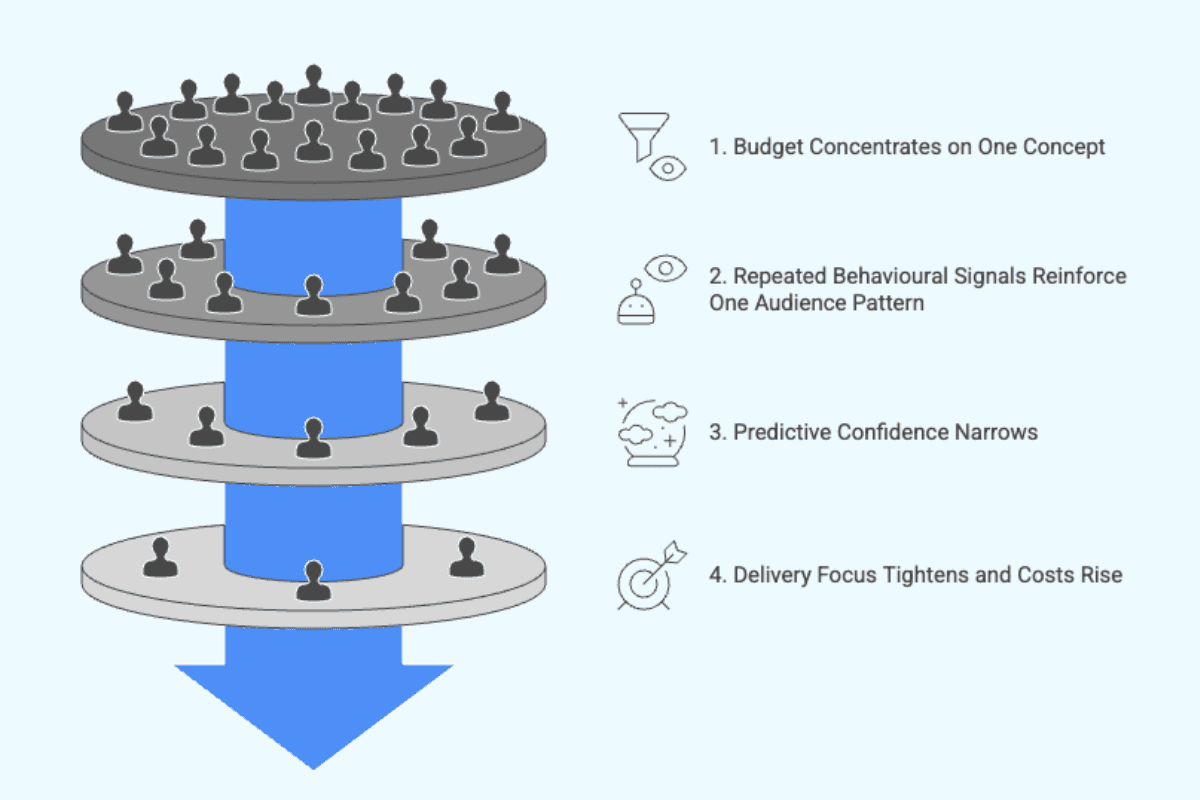
Creative compression shows how normal optimisation gradually reduces exploration. Each stage strengthens reliance on one buying motivation until the scale becomes constrained.
What you need is expansion that comes from introducing different motivations that attract different behavioural clusters.
How to Expand Buying Motivations
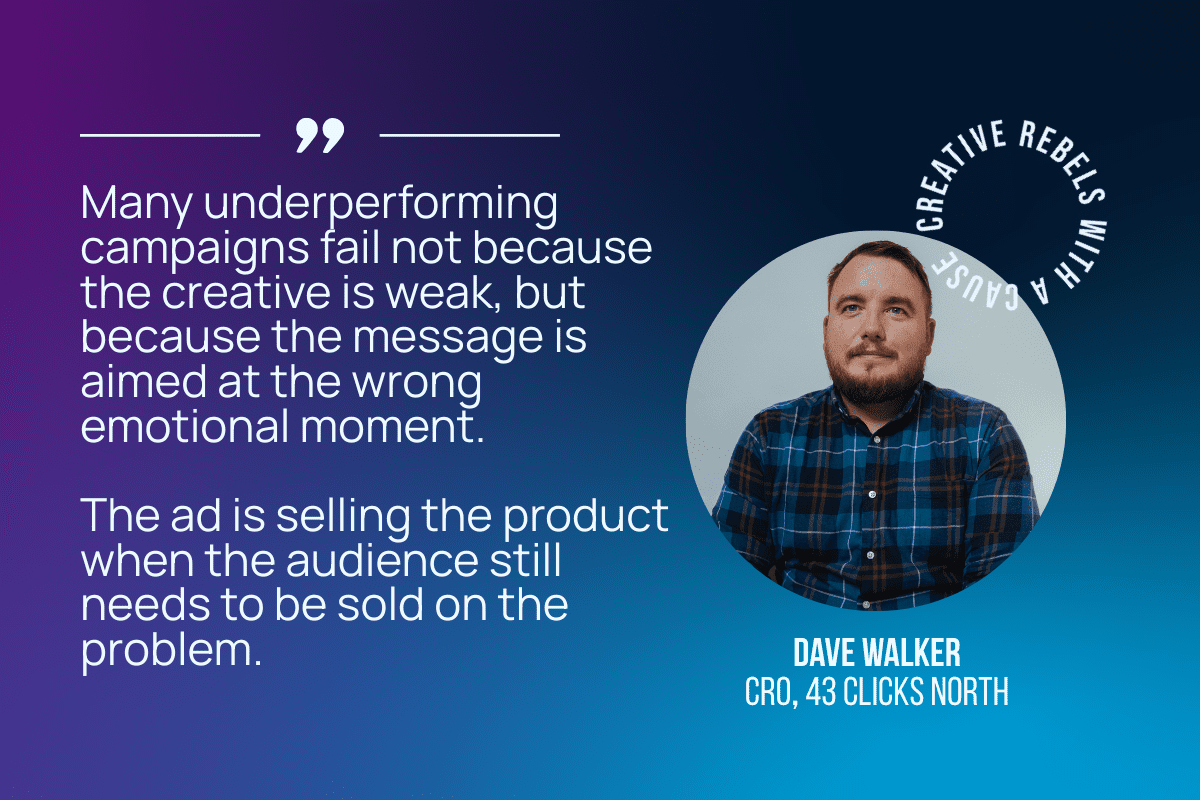
Most brands confuse format variation with motivation variation. Changing hooks, headlines, or visuals inside the same core message does not expand learning. It only reinforces the same behavioural cluster.
When that mismatch exists, performance concentrates around the few people already ready to buy, and compression begins. Expansion requires introducing new psychological entry points into the purchase decision.
Step 1: Identify Your Current Dominant Motivation
Before expanding, define what is currently driving most of your conversions.
Ask yourself these:
- Is your best performer price-driven?
- Is it problem-solution focused?
- Is it an aspirational identity?
- Is it urgency or scarcity?
- Is it social proof?
You will usually find one clear pattern. If your top ads all communicate “save money,” then your account is likely clustered around price-sensitive buyers. If everything is “transform your skin,” you are anchored to outcome-driven buyers. You cannot expand if you do not know what is dominating.
To expand beyond one dominant buying reason, you need to understand how different audience segments interpret your messaging. See our guide on Matching Creative to User Intent in Meta Ads.
Step 2: Define New Buying Motivations
Once you identify the dominant motivation, now is the time to introduce different psychological entry points into the purchase decision. For example, if your dominant angle is “Save money”, you are attracting price-sensitive buyers.
If you introduce “Premium quality that lasts longer”, you are now speaking to durability-driven buyers. If it is about “Feel confident wearing this”, you are now targeting identity and emotional payoff. These are different purchase triggers.
When defining new motivations, think in terms of:
- What fear does this remove?
- What desire does this amplify?
- What friction does this reduce?
- What identity does this reinforce?
- What long-term outcome does this promise?
If the answer overlaps heavily with your current winning ad, you are still inside the same cluster. True expansion means the buyer would say, “I am buying this for a different reason than the other ad.” That difference is what creates new learning pathways inside the algorithm.
Step 3: Separate Motivations Structurally So Learning Does Not Collapse
Meta will continue allocating toward the established behavioural cluster if you put a new motivation. The stronger signal will overpower the weaker one.
To prevent this:
- Give each new motivation its own structured testing space.
- Assign a defined budget that is protected from the dominant angle.
- Avoid immediately comparing it to your best performer in the first few days.
You are not trying to beat the winner instantly, but instead allowing the system to discover whether this motivation can form its own conversion pattern.
If you mix everything too early, compression continues. The algorithm simply reallocates back to the strongest historical pattern.
Step 4: Measure Signal Diversity, Not Just Immediate Efficiency
When you expand motivations, early performance may look less efficient than your dominant winner. That is expected. New motivations often show slower conversion velocity in the first few days or slightly higher cost per acquisition at the beginning.
You need to look for signals that diversification is occurring:
- Are you seeing conversions from audiences that previously did not convert?
- Are engagement metrics distributed differently?
- Is the frequency spread more evenly?
- Is the overlap with the dominant ad decreasing?
These signs indicate that your account is no longer clustering around a single behavioural group.
Step 5: Expand Gradually Once the New Motivation Proves Stability
After a new motivation shows consistent conversion behaviour across multiple days, do not rush to match the budget of your dominant angle.
Aggressive scaling forces the algorithm to rapidly increase volume within that cluster. If it cannot find enough matching users at scale, it will revert to familiar patterns or push frequency too high. You should increase it in small percentage increments.
For example:
- The ad set is spending £100 per day, increase it to £120–£130.
- Hold that level for 48–72 hours.
- Evaluate stability before adjusting again.
If performance remains within your acceptable CPA range and conversion volume scales proportionally, proceed with another controlled increase. If CPA spikes sharply or conversions stall, pause scaling and allow delivery to stabilise.
When done correctly, your account no longer relies on one behavioural pattern to carry revenue. That is how scale becomes durable rather than fragile.
How You Reinforce Compression Without Realising It
Creative compression happens because of repeated small decisions that keep pushing the budget back to the same buying motivation. Here is how that typically plays out.
Ending New Angles Too Fast
You launch a new motivation, and after two or three days:
- CPA is higher than your dominant ad
- Volume is lower
- ROAS looks weaker
So you turn it off. The issue is not performance, but the evaluation speed. A new motivation has no historical reinforcement. It needs time to form its own conversion pattern.
Each time you shut it down early, you send it back to the dominant angle. Over time, your account becomes more concentrated, and alternative motivations never get the chance to stabilise.
Duplicating the Winning Ad Instead of Expanding
When performance softens, many brands duplicate the top ad and tweak surface elements: a new hook, a different headline, swapped visuals.
But the buying reason stays the same.
If your dominant message is “Save 30%,” three variations of “Save 30%” still attract the same price-sensitive buyer. That does not expand demand. It reinforces the same behavioural group.
From the system’s perspective, you are confirming that this is the safest path for budget allocation, and therefore, this deepens concentration.
What Happens Next
If you continue this pattern, scaling will feel increasingly unstable. Costs will rise faster with spending increases. Performance swings will become sharper because the system has fewer alternative conversion pathways to rely on.
When you recognise these patterns, stop reinforcing them and begin doing what we have discussed on how to build a more diversified, stable scaling structure.
Tip 2: Build Delivery Stability Before You Try to Scale
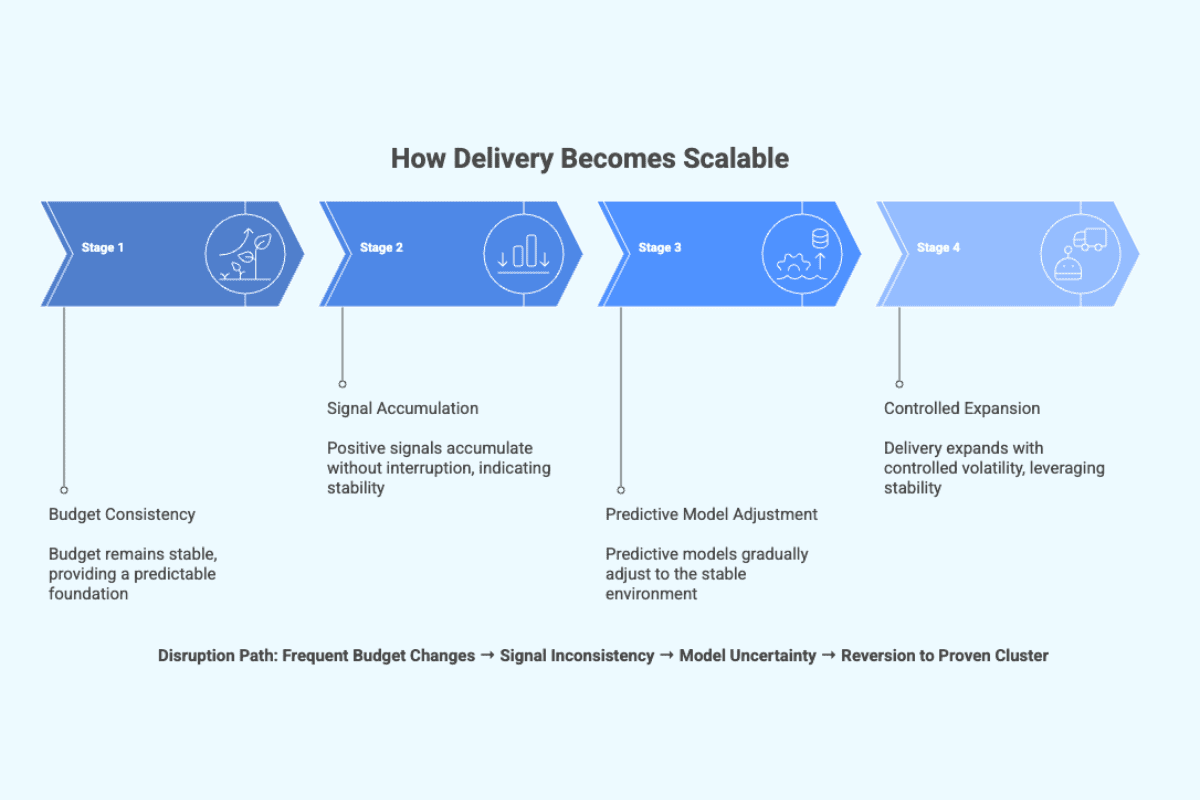
You can diversify buying motivations correctly and still struggle to scale if your delivery environment is unstable. Meta cannot form reliable predictive models if budgets shift too often or structure changes repeatedly.
Frequent or aggressive changes disrupt stability faster than most people realise. Large budget jumps, sudden cuts after one weak day, or constant edits send mixed signals into the system.
You will usually see it in:
- Sudden CPA spikes
- Inconsistent daily volume
- Performance that swings without a clear reason
To have steadier results, use a structured adjustment framework. The section below will help you reduce volatility and keep scaling under control. So how do we maintain stability across Meta’s ad delivery?
Step 1: Control Timing and Reduce Unnecessary Edits
Delivery needs uninterrupted time to interpret performance signals. Budget changes, targeting adjustments, and structural edits all force redistribution of impressions. If you intervene too often, learning never compounds.
Use a defined review window of three to five days. Make structural decisions inside that window only. Outside of it, let the system run without interference.
If you increase the budget from £100 to £120 and the next day shows a higher CPA, that alone does not justify another change. Short-term fluctuation during recalibration is normal.
For mature scaling campaigns, avoid editing active ad sets. Launch new tests separately instead of modifying what is already stable.
Step 2: Apply Budget Pressure in Proportion to Signal Strength
The larger the budget increase, the more aggressively the system must expand its reach. If signal depth is still forming, large jumps stretch delivery beyond proven behaviour.
What you should do is increase in measured steps, such as 15–20%, and hold steady for several days. Evaluate the average CPA range and volume trend before scaling again.
Sudden CPA spikes and rapid frequency jumps usually signal that budget pressure was applied too aggressively.
Step 3: Separate Testing From Scaling to Protect Learning Depth
Testing and scaling should not run inside the same structure. As we have discussed, putting new creatives into a scaling campaign will only shift automatically toward existing winners.
To prevent it, allocate a defined portion of spend, such as 20–30%, to testing in separate campaigns or ad sets. Let new creatives prove stable performance over several days before moving them into scaling. Keep scaling environments focused on continuity. Keep testing environments focused on experimentation.
That separation preserves performance stability while still allowing controlled expansion.
What Is Causing Your Ad Performance to Become Unstable
Instability is the result of operating habits that slowly trained delivery to expect constant adjustment, and here are some examples:
Expecting Immediate Efficiency at a Higher Spend Level
A campaign spending £100 per day operates inside a tighter predictive zone than one spending £150 or £200. At lower spend, delivery can stay concentrated around the most responsive audience pocket. At higher spend, that pocket alone is rarely enough to sustain volume.
The mistake happens when you expect performance at a higher budget to mirror the efficiency profile of the lower one.
For example, a campaign producing a steady £45 CPA at £100 per day may move into a £48–£52 range once spend increases. That shift does not automatically signal deterioration. It reflects a broader reach and a slightly wider audience pool.
Treating that shift as a failure and reverting to the original budget prevents the campaign from establishing a new equilibrium at scale. Efficiency can remain strong without being identical to the previous baseline.
Mistaking Constant Intervention for Optimisation
Frequent changes feel productive because something is always being adjusted. But in reality, it keeps delivering in a perpetual adjustment state.
Each change introduces new variables, making it harder to determine what actually improved performance and what simply altered conditions. Optimisation is not measured by how often you act. It is measured by whether your actions create stable performance patterns over time.
These habits can be reversed. You just need to change how you respond. Slow down intervention, scale from stability instead of spikes, and allow learning to mature before applying more pressure.
Tip 3: Scale Only When Your Account Has the Capacity to Absorb It
Strong performance at a lower budget does not mean your account is ready for a higher one.
If your campaign performs efficiently at £300 per day, that only proves it works inside that spend range. It does not automatically mean it can handle £500 or £700 per day without cost instability.
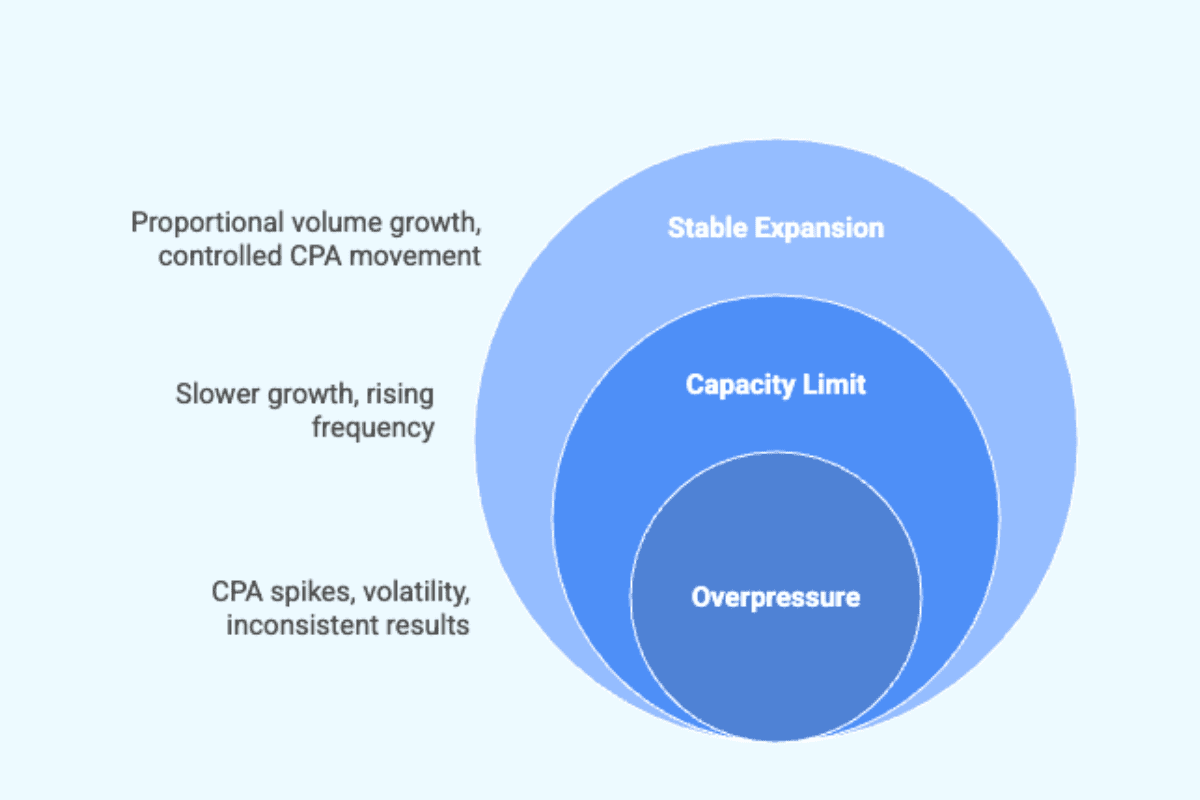
As the budget increases, Meta must reach beyond the most responsive segment of your audience. At first, growth can remain proportional. Conversions increase, CPA stays within a controlled range, and reach expands steadily.
The diagram below illustrates how increasing the budget applies pressure to your account and how performance shifts as you move from stable expansion toward saturation.
Every account has a limit. As you approach it, frequency rises faster than reach, CPA begins drifting upward, and incremental conversions become more expensive. If you continue pushing the budget past that point, costs spike and delivery becomes inconsistent.
Scale should follow capacity. Increase budget in proportion to signal strength and audience depth, not faster than the account can realistically support.
Step 1: Test Proportional Conversion Growth
Increase the budget of one stable campaign by 15 to 20%. Do not change targeting, creatives, placements, or bidding. Let it run for at least 72 hours so the system can recalibrate without interference.
Then compare the percentage change in spend against the percentage change in conversions.
If spend increases 20% and conversions rise at least 14 to 20%, your account is showing healthy elasticity. The system is able to generate near-proportional output from additional budget. A temporary CPA lift under 10% that stabilises within a few days is acceptable.
This will give you an idea of whether adding more budget produces meaningful incremental volume
Step 2: Confirm Audience Expansion
Now evaluate reach and frequency during the same test period.
When absorption capacity is healthy, reach expands alongside spend and frequency rises gradually. For example, a 20% budget increase paired with double-digit reach growth and only a modest frequency lift suggests the system is finding new users.
If reach barely increases, but frequency jumps quickly, impressions are concentrated within the same pool. That indicates saturation.
With this, you can verify whether growth comes from broader exposure rather than heavier repetition.
Step 3: Calculate Marginal CPA
Blended CPA can mask scaling inefficiency. To isolate the true cost of incremental growth, calculate marginal CPA:
(New Spend – Old Spend) ÷ (New Conversions – Old Conversions)
This shows what you paid for the additional conversions only. If your baseline CPA is £50 but marginal CPA rises to £75 or £85, incremental volume is significantly more expensive. Even if overall CPA still looks stable, the new budget is operating at a weaker efficiency level.
Marginal CPA is the clearest economic validation of scaling capacity. This measurement separates market limitation from structural limitation. That distinction determines your next move: increase the budget with confidence, or improve the system before applying more pressure.
Mistakes That Destabilise Your Meta Performance
The following patterns often cause ad performance instability and should be corrected before increasing spend further.
Treating One Strong Week as Proof of Unlimited Headroom
A campaign performs well at £70 per day, so you assume it can handle significantly more spend. At lower budgets, Meta focuses on the most responsive audience segment. That small group converts easily, which is why performance looks strong.
Strong results in a narrow audience do not automatically mean the account is ready to perform at broader scale.
Jumping Spend Tiers Instead of Climbing Them
Moving from £100 to £200 forces the system to immediately find twice the conversion volume. If your account lacks enough data or audience depth, delivery stretches too quickly. CPA rises, and daily performance becomes unstable.
Increase the budget step by step. Give the system time to adjust and stabilise before pushing further.
Trying to Solve Revenue Gaps With a Budget Alone
When revenue drops, increasing spend can feel like the fastest way to recover results. But budget alone does not fix structural problems.
If conversion rates are weak, creative is misaligned, or your audience pool is too narrow, adding more spend only amplifies those weaknesses. Costs rise because you are scaling inefficiency, not performance.
Before increasing spend, identify where the breakdown is happening:
- Is CTR dropping? The hook may be weak.
- Are clicks strong but conversions falling? The message or landing page may be misaligned.
- Is frequency rising without reach growth? You may be saturating the same audience.
Fix the layer that is underperforming first. Strengthen conversion rates, diversify motivations, or expand audience depth. Then scale.
Make Your Meta Ads Growth More Stable and Predictable!
You do not need more random tests or bigger budget jumps. You need a clear structure that helps your account grow in a steady way.
At 43 Clicks North, we design Meta accounts for controlled expansion. That means:
- Motivations structured to expand demand, not reinforce one cluster
- Testing environments that do not destabilise scaling campaigns
- Budget increases mapped to real absorption capacity
- Clear economic validation before pushing into higher spend tiers
If you are tired of results breaking every time you increase the budget, it is time to fix the foundation. Our team can help you build an account that scales with control. Reach out and let’s make it happen!
Stopped growing online?
We know how to fix that.
We start with your data, not your channels.
Commercial, market, performance, customer and behavioural data, woven into one view rather than five separate reports.
It shows where your profit comes from, which activities earn their place, which are dead weight, and what's worth doing next.
We typically find 15-30% in wasted marketing spend in the first 3 months.
Channels are the tools; making your business more money is the objective.
Latest News
See all
5 Conversion Blockers That Hurt Black Friday Sales
Shoppers are ready to buy this season, but site blockers can send them to competitors. Discover 5 mistakes to avoid and how to fix them.


5 Strategies to Boost Ecommerce Landing Page Conversions
Your ecommerce landing page is critical in the success of your online store. Join 43 Clicks North as we share our tips on boosting your conversion rates.

How building/nurturing communities can benefit your brand
One of the most enigmatic marketing strategies, has always been communities. Find out how building & nurturing communities can benefit your brand with 43CN.