
Stop Repeating One Buying Reason on Meta


Right when you feel like you’ve figured out the growth formula, progress slows down. The same PPC strategy that helped you gain traction stops improving results. This slowdown happens when you keep scaling the same core message that drove your early success. The system becomes very efficient, but only within a small group of people who respond to that one reason to buy.
Many e-commerce brands react by launching more ads, increasing budgets, and pushing the same angle further. This keeps Meta showing your ads to the same type of audience.
That’s the major problem this guide focuses on. You’ll see how to move beyond a single buying reason, connect with different motivations, and create space for steady, long-term growth again.
Identify If You’re Trapped in One Buying Reason
Before you try to scale, you need to know whether your account is truly expanding demand or just pushing harder into the same psychological trigger.
An account can look diversified because it runs multiple campaigns and creatives. If they all convert for the same core reason, it is concentrated.
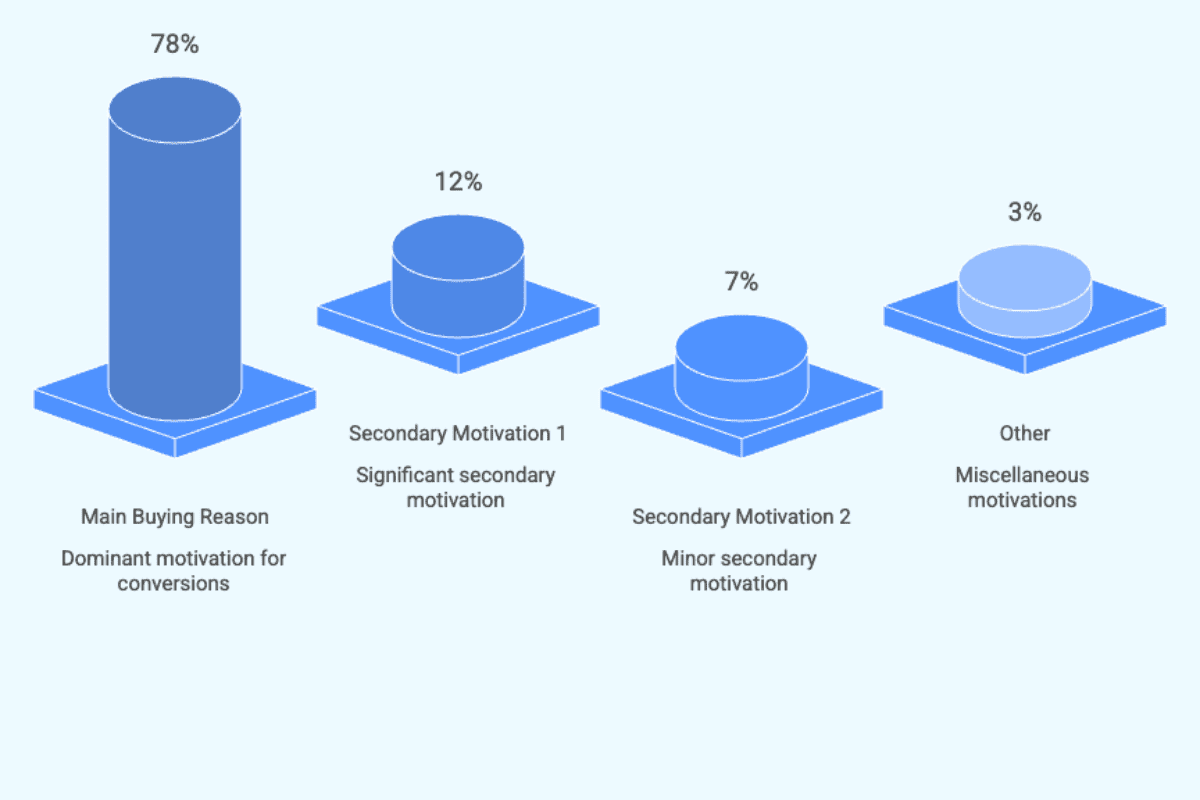
In this diagram, each cylinder represents a different buying reason. One cylinder towers over the others. It drives most of the revenue, and the remaining motivations contribute very little.
The problem emerges as you increase spending on that dominant motivation.
- Costs rise faster as you scale.
- Frequency climbs and performance decays.
- Creatives fatigue sooner.
- Small market shifts impact revenue more than expected.
You need to have a healthier distribution that shows more balanced cylinder heights, which signals that multiple motivations contribute meaningfully to revenue. That wider coverage gives you more room to grow before performance tightens.
Below, you’ll see how to check whether most of your results are coming from just one buying reason and one type of customer behaviour.
How to Diagnose and Expand Beyond One Driver
Step 1: Define the Reason People Buy From Each Campaign
Start by turning every live campaign into one simple sentence:
“This campaign converts because it promises ______.”
Ignore the format, visuals, and copy style. Focus only on the core reason someone decides to buy. After you write those sentences, group the campaigns based on shared buying motivations. Then calculate two things:
- Percentage of total spend per motivation
- Percentage of total conversions per motivation
If more than 60% of spend and conversions are driven by a single reason to buy, your account relies on a single psychological driver. To remove subjectivity, assign a reinforcement score:
- 1–2 motivations controlling 70%+ of results = High reinforcement risk
- 3–4 motivations contributing meaningfully = Moderate reinforcement
- 5+ motivations with balanced distribution = Healthy diversification
This gives you a structural snapshot of your buying-reason mix.
Step 2: Measure Your Account’s Audience Concentration
Now assess whether the same behavioural segment is carrying performance. Inside Ads Manager, break results down by age, gender, region, audience source, and placement.
Calculate the percentage of total conversions and revenue coming from the top-performing segment. As a reference:
- 40–50% from one segment can be natural dominance
- 60–70% indicates narrowing
- 75%+ signals structural concentration
Step 3: Identify Reinforcement Through Delivery Signals
Review 30-day trends within your dominant segment. Focus on frequency growth, CPM movement, and CPA stability despite rising exposure.
If frequency rises and CPA holds steady, it means it is saturated. Rising CPM within that segment reinforces this pattern, as competition increases for the same type of buyer.
At this stage, you have diagnosed concentration. Now you need to move into the expansion phase.
Step 4: Extract New Buying Reasons
After identifying your dominant motivation, deliberately search for adjacent ones. Most accounts never do this systematically. Start by mining customer language from:
- Post-purchase surveys
- Support tickets
- Reviews
- Sales calls
- Live chat transcripts

You need to uncover moments where customers describe a feeling, tension, or identity shift that is different from your main angle. As our Creative Lead, Emily puts it:
That recognition is what separates a new motivation from a surface-level variation. If your dominant driver is “save time,” but customers repeatedly mention reduced stress, increased confidence, or feeling more in control, those are not copy tweaks. They are separate psychological reasons to buy.
You can also map motivations into broader outcome categories:
- Time relief
- Financial gain
- Risk reduction
- Identity elevation
- Emotional relief
The goal is not to abandon your primary driver but to layer in adjacent motivations to widen the base.
Step 5: Build a Controlled Diversification Test
Diversification should not disrupt core revenue. It should run in parallel. To achieve that, follow this structure:
- Allocate 15–25% of spend to “Motivation Expansion” campaigns. Keep this separate from core performance campaigns.
- Test new motivations against the same audience first. If the buying reason resonates with your existing audience, you validate psychological viability before expanding reach.
- Measure early-stage signals such as hook rate, landing engagement depth and assisted conversions, not just CPA. New motivations often show engagement lift before conversion lift.
- Define a 30-day decision rule before launch. Decide in advance what qualifies as validation, iteration or removal.
If you don’t set clear criteria upfront, you’ll default to what already works. The dominant buying reason feels safer because it protects short-term results. As a result, new motivations get judged too quickly and often shut down before they have room to develop.
How You End Up Scaling the Same Audience Again
At this point, you’ve identified where your results are concentrated and created a plan to expand into new motivations. The biggest risk is slowly slipping back into pushing the same dominant driver again without realising it.
Letting Meta Reallocate Budget to the Fastest Signal
Meta’s delivery system cares about signal strength. The fastest-converting cluster will absorb spend because the algorithm is built to chase efficiency.
This creates a reinforcement loop:
- You introduce a new buying reason →
- The dominant motivation converts faster in early learning →
- Delivery shifts impressions toward that cluster →
- The new motivation receives weaker data density →
- Results appear unstable →
- You reduce spending →
- The account recenters around the original driver.
Diversification fails if your expansion campaigns share the same optimisation goals, learning cycles, or flexible budget rules as your core campaigns. Meta will shift delivery back to the strongest existing audience. If you do not protect spending at the campaign level, you are inviting the system to erase it.
Expecting New Motivations to Match Your Main CPA Immediately
Many concentrated accounts follow an unspoken rule: “If it doesn’t hit our main CPA within two weeks, it doesn’t work.” That rule protects short-term efficiency, but also blocks long-term growth.
A new buying reason usually does not win on cost right away. It is not competing on speed, but for reach. You are trying to see whether a different type of buyer responds to a different reason to purchase.
When a new motivation starts working, it often shows up in early behaviour signals before it shows up in purchases. You might notice:
- More people are stopping to watch the ad
- Longer video watch time
- More scrolling and reading on the landing page
- More add-to-cart actions without immediate checkout
- Conversions that happen a few days later instead of the same day
These are signs that interest exists, even if CPA is still higher than your main driver. If you demand CPA equality too early, you shut down motivations that simply need time to gather enough data.
If you remove every new motivation the moment it looks less efficient, your account will depend on one single reason forever.
Expanding Reach Before Validating Motivation
Another mistake is increasing your audience too fast. You launch a new buying reason and immediately widen targeting. When results are weak, you don’t know what caused them. Was the message weak? Or did it reach people who were never a good fit?
If you change the message and the audience at the same time, you mix two variables. That makes it hard to know what actually failed. A better approach is slower and more controlled.
Start by testing the new motivation inside your existing audience. Watch engagement signals. See whether it supports conversions, even if it doesn’t win on CPA right away. Once you confirm the buying reason connects, then expand to colder audiences.
Growth doesn’t come from reaching more people immediately. It comes from proving a different reason to buy works first, then scaling it outward with control.
Don’t Confuse Variation Testing With Concept Testing
Some e-commerce owners think they are testing properly because new creatives go live every week. Most of those changes happen at the surface level, like changing headlines, images and hooks. There is a clear difference between testing variations and testing new concepts.
Variation testing improves performance inside an existing buying reason. It helps you extract more from the same audience. Concept testing introduces a different reason to care. It gives you access to a different type of buyer.
If you do not separate these two clearly, optimisation will overpower expansion. Meta will keep refining what already works instead of helping you grow into new demand.
The separation must happen in three places: how you define ideas, how you structure campaigns, and how you judge performance.
How to Build a Concept Testing System
Step 1: Label Every Test Before It Goes Live
Before launching a new creative, decide whether it is a variation or a concept.
A variation keeps the same core promise and changes delivery. For example, you might promote “Save 30%” with a new visual, a different headline angle or a shorter video. The motivation remains price-driven.
A concept changes the reason someone should care. Instead of focusing on saving money, you might emphasise premium quality, long-term durability, identity alignment or risk reduction. The primary driver shifts.
Label your tests clearly so the platform doesn’t optimise every new concept into just another version of the same motivation.
Step 2: Build Clear Concept Territories
Choose two to four distinct buying drivers in your category and build each one into a complete territory rather than a single ad.
A concept territory should include:
- A defined target mindset
- A core promise built around that motivation
- Supporting proof that reinforces it
- A call to action aligned with that logic
For example, in e-commerce, a performance-led concept would rely on measurable results and product validation. An identity-led concept would highlight lifestyle alignment, belonging or status signals. Mixing these weakens both.
Each territory must feel internally consistent. That consistency allows the algorithm to recognise a distinct behavioural pattern.
Step 3: Separate Campaign Structure by Motivation
Do not mix concepts inside one ad set. Instead of structuring campaigns by format or placement, organise them by motivation. Each concept should have its own campaign or clearly separated ad set so performance data stays clean.
This prevents a stronger, established concept from absorbing the delivery away from a new one. Structural separation protects exploration.
Step 4: Allocate Budget Intentionally
Most accounts unintentionally give 80 to 90% of the spend to one dominant angle. That guarantees reinforcement.
Instead, define a clear split between optimisation and exploration. For example, you might allocate 60% of the spend to proven concepts and 40% to structured concept testing.
Exploration needs enough budget to stabilise. Without sufficient delivery, the system cannot gather meaningful signals about a new motivation.
Step 5: Define Evaluation Criteria Before Launch
Variation tests should be judged on efficiency metrics such as CTR, CPA and CVR inside a known segment.
Concept tests require broader evaluation. In addition to cost, review:
- Segment contribution changes
- New customer rate
- Downstream lead quality
- Audience distribution shifts
A new concept may cost a bit more at first, but it can attract different types of buyers and make your account more stable over time.
This approach transforms testing from reactive creative swapping into a deliberate growth system. When you separate them properly, improving performance inside one group does not quietly replace efforts to grow into new ones.
How Concept Testing Collapses Back Into Optimisation
These patterns erase the separation between variation testing and concept testing, pushing your account back toward refining what already works.
Calling Visual Changes “New Concepts”
For example, you sell premium trainers and your live ads say:
- “Save 15% Today”
- “Best Value Running Shoes”
- “Limited Offer Ends Soon”
All three ads attract discount-driven buyers. The system then optimises toward people who respond to offers and time pressure. Changing presentation does not change motivation.
If someone would still buy for the same reason, you are refining the same psychological trigger. Your ad account feels active, but demand remains narrow.
Mixing Concepts Inside One Campaign
Sometimes brands do introduce a genuinely different buying reason, but structure prevents it from developing. Suppose you run a skincare brand and test:
- Concept A: Clinical results and proven ingredients
- Concept B: Luxury experience and self-care identity
If both concepts sit inside the same campaign or ad set, the faster converter absorbs impressions. If clinical messaging historically performed well, delivery shifts toward that pattern. The luxury message receives less exposure, gathers weaker data and appears unstable.
The issue there was signal density. Concepts need separation so each can build its own behavioural pattern.
Budget imbalance creates the same problem. If 80% of the spend remains behind your dominant angle and only 10–20% supports exploration, new motivations never receive enough exposure to stabilise. Low spend produces weak signals. Weak signals make performance look unstable. That instability causes you to turn the concept off before it has a real chance to work.
Without structural and budget protection, optimisation pressure quietly crowds out expansion.
Interrupting Learning Before It Stabilises
Early performance of your new ad may look slower than a mature discount campaign. If you compare them after a few days and shut the new concept down, you protect short-term efficiency at the expense of long-term expansion.
Constant editing causes the same problem. Changing headlines, swapping creatives or narrowing audiences every few days prevents the system from forming a stable association between that motivation and a behavioural group.
Concept testing requires defined evaluation windows and enough uninterrupted time for patterns to emerge. Without stability, no new motivation can prove itself.
Each of these mistakes removes the boundaries between optimisation and exploration. When those boundaries disappear, Meta does what it is designed to do: prioritise the strongest existing signal. That is why accounts drift back to one dominant buying reason.
Protect New Motivations From Being Absorbed
When you introduce a new buying reason, you are competing against your own history. Meta already trusts that one strong driver that has been converting. So even if you structure your test properly, expansion can quietly collapse.
This creates three silent risks.
- Delivery consolidation: Impressions slowly shift back to the strongest historical motivation. Your new angle receives less exposure over time.
- Signal dilution: Because the new motivation does not receive stable delivery, it cannot gather enough clean data. The system never gets a fair read on whether it works.
- Re-optimisation toward historical behaviour: Small performance gaps early on cause the system to drift back to what worked before. Your test turns into another version of the same buying reason.
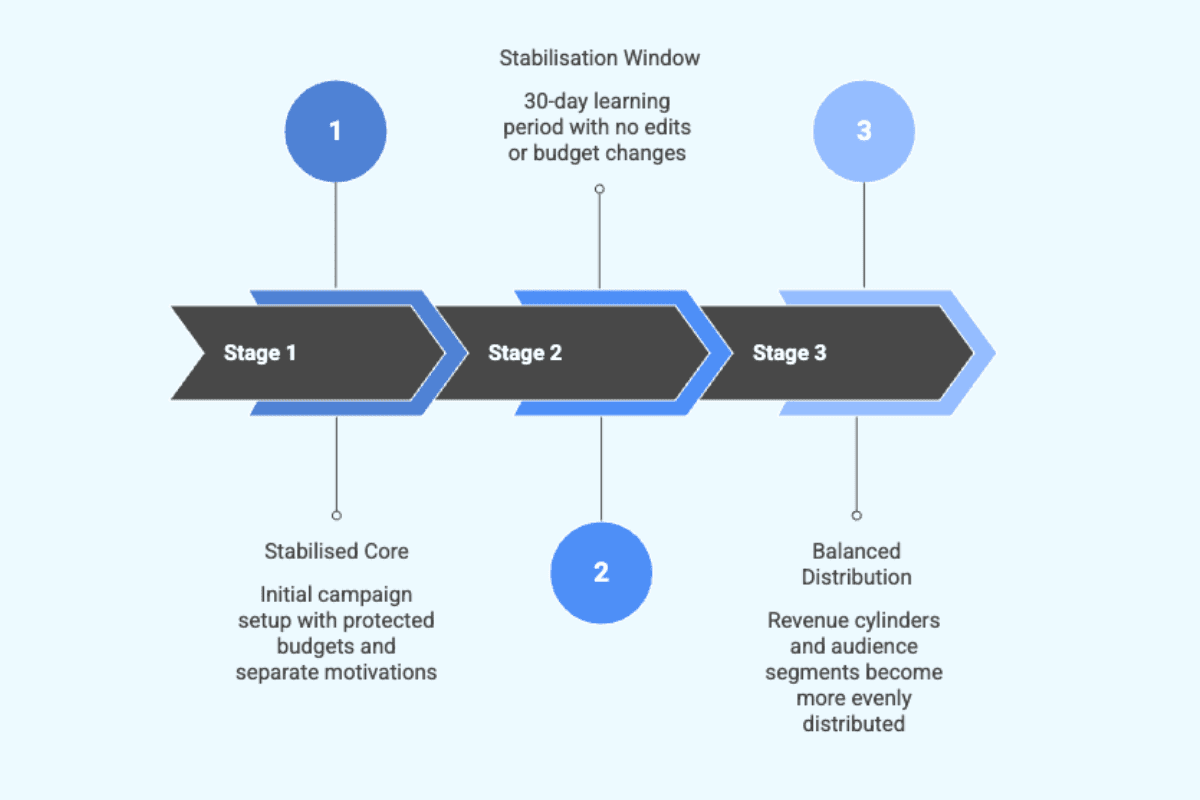
Even a strong new idea will not survive if it competes inside the same optimisation environment as your dominant driver. Without protection from budget shifts, early CPA comparisons, and frequent edits, the algorithm simply absorbs it.
So what does protection actually look like in practice?
Protection means separation. Separate campaigns and separate budgets. A fixed learning period where you do not compare the new motivation against your historical CPA too early. This gives the new buying reason enough space to stabilise. Below is how to achieve it.
How to Keep New Motivations Alive Long Enough to Work
Step 1: Separate Optimisation Windows
Your core campaign and expansion campaign should not live on the same timeline.
The core driver has months of data, and it converts fast, while a new motivation has no history and needs time to find the right pockets of buyers. If you judge both after 7–14 days using the same CPA target, the new one almost always loses.
Instead, set clear rules before you launch.
- For most accounts, this means a minimum of 30 days or a defined spend threshold, such as 3–5x your target CPA in spend. The goal is to allow enough delivery for patterns to form.
- Do not compare the new motivation to your best historical CPA. Compare it to a broader success range. For example, you may accept a higher CPA during the first month if: CTR is competitive, conversion rate improves over time, new customer percentage increases, or audience distribution expands.
- Failure is not “CPA is higher after 10 days.” Failure is sustained spend with no conversions, or CPA staying 2–3x above your acceptable range after sufficient delivery.
- Every time you change creative, budget, or targeting, you reset learning. Only intervene if performance truly breaks, not because it feels uncomfortable.
If you do not separate timelines, efficiency always wins over expansion. And the new motivation never gets enough space to prove itself.
Step 2: Lock Budget at the Campaign Level
Use fixed campaign budgets for expansion and keep new motivations out of CBO structures that also contain mature, high-performing drivers.
During the learning phase, avoid automated budget rules that increase spend on “best performers” or cut spend on higher CPA ad sets, because those rules quietly drain your exploration effort. Decide your expansion budget before launch and treat it as protected capital, not leftover spend after revenue goals are met.
This should be a defined percentage of total spending, such as 15–25% of your monthly budget, committed to new motivations and left untouched throughout the stabilisation window.
Step 3: Watch Distribution Shifts, Not Just CPA
When you test a new motivation, do not focus on CPA alone. A new buying reason usually shows progress in who is converting before it improves how much it costs.
Start with your new customer percentage. If more first-time buyers begin converting, your message is reaching beyond your usual audience. That is an early expansion signal.
Then look at how conversions are distributed across age groups, regions, and other segments. If sales begin appearing in audiences that rarely purchased before, and conversions are no longer concentrated in one tight demographic, your reach is widening. That shift is not random. It means the motivation is connecting with different types of buyers.
Expansion starts with audience breadth. Cost efficiency tends to improve after the system gathers enough data from that broader base.
If you judge success only through short-term blended CPA, you risk turning off a motivation that is quietly expanding your market and building future scale.
Step 4: Do Not Merge Too Early
Once a new motivation shows signs of life, there’s a temptation to merge it back into core campaigns “to scale faster.” That collapses the separation.
When you mix mature and emerging motivations:
- The stronger one regains dominance.
- Data blends.
- You lose clarity on which driver influences which buyer.
Keep concept territories independent until they demonstrate stable contribution across multiple cycles.
Mistakes That Cause Expansion to Fail
Running Too Many New Motivations at Once
You divide learning power when you introduce multiple new buying reasons simultaneously. Each motivation:
- Gets fewer impressions
- Generates slower feedback loops
- Competes against other unproven ideas
Because Meta allocates budget toward early efficiency, slight performance differences cause uneven delivery. One idea may temporarily outperform the others. The remaining motivations never reach enough volume to validate themselves. They end from underexposure, not poor positioning.
Treating Optimisation Tools as Discovery Tools
If you assume Meta will “figure out” the new motivation on its own, you are misunderstanding how the system works. The algorithm is designed to refine what already converts and allocate toward proven signals. It is not built to explore new behavioural territory.
If you rely on:
- Broad targeting without guardrails
- CBO across mature and new concepts
- Automated rules to adjust spend
You are asking an efficiency engine to behave like a research engine. That contradiction is exactly how expansion collapses. Expansion requires deliberate exploration, not passive reliance on optimisation.
Transform Your Meta Account Into a Stable Growth System!
At 43 Clicks North, we design Meta accounts for e-commerce that protect exploration before pushing for scale. That means:
- Clear separation between testing campaigns and scaling campaigns
- Controlled environments where new motivations can prove themselves without harming mature revenue drivers
- Budget allocation that prioritises signal clarity before volume
- Defined validation thresholds before any concept graduates into higher spend tiers
If your growth keeps stalling because every expansion attempt disrupts what already works, the issue is not effort. It is the structure. Build an account that can explore safely and scale intentionally. Reach out, and let’s design it properly!
Stopped growing online?
We know how to fix that.
We start with your data, not your channels.
Commercial, market, performance, customer and behavioural data, woven into one view rather than five separate reports.
It shows where your profit comes from, which activities earn their place, which are dead weight, and what's worth doing next.
We typically find 15-30% in wasted marketing spend in the first 3 months.
Channels are the tools; making your business more money is the objective.
Latest News
See all
5 Conversion Blockers That Hurt Black Friday Sales
Shoppers are ready to buy this season, but site blockers can send them to competitors. Discover 5 mistakes to avoid and how to fix them.


5 Strategies to Boost Ecommerce Landing Page Conversions
Your ecommerce landing page is critical in the success of your online store. Join 43 Clicks North as we share our tips on boosting your conversion rates.

How building/nurturing communities can benefit your brand
One of the most enigmatic marketing strategies, has always been communities. Find out how building & nurturing communities can benefit your brand with 43CN.