
How to Fix Attention Gaps That Hurt Meta Performance


In the modern Meta advertising landscape, many brands are witnessing performance declines that appear to be "traffic problems", but their reach and CPMs often remain stable. This phenomenon is actually an attention gap, where users have simply stopped reacting to the content, causing the algorithm's learning process to stall.
With most ad outcomes now directly attributable to the creative asset, the platform has shifted toward a "creative-first" delivery model under the Andromeda update. As a result, creative fatigue, where audiences ignore overexposed messaging, leads to rising costs and declining ROI.
This means improving performance starts with fixing attention and signal quality. The tips below show how to do that through better hooks, creative strategy, and cleaner data.
Share it with friends

Master the "Thumb-Stop" Hook
The average attention span may reach 8 seconds, but your ad only gets less than 3 seconds to capture attention. That moment determines whether your ad gets seen at all. If users don’t stop, delivery slows, and the algorithm receives weaker signals, which limits performance from the start.
A strong hook creates an immediate pattern break that gives people a reason to pause. This often comes from introducing a problem, sparking curiosity, or presenting something that feels instantly relevant.
Start with the problem the user already recognises. For example:
- “Still dealing with frizzy hair even after using conditioner?”
- “Your mattress still leaves you waking up with back pain?”
- “Your phone battery still dies before the end of the day?”
This attracts the right audience and improves signal quality. It makes the message clearer and easier to relate to.
From there, the first frame carries most of the weight, so visual execution needs to reinforce the hook. Bold on-screen text, tight framing, or unexpected movement help guide attention. A close-up face, a quick zoom, or a split-screen, such as “Expectation vs Reality,” gives the brain a clear reason to pause. Once attention is captured, curiosity keeps it. This works best when there is a gap that needs resolution.
At the same time, the hook needs to match the viewer’s level of awareness so the message feels relevant.
- Cold: “Why your skin still breaks out after trying everything”
- Warm: “That cleanser might be causing your breakouts”
- Hot: “48 hours left before this ends.”
To understand whether this is working, measure it using the Thumb-Stop Ratio (3-second views over impressions). A low ratio shows that users are not pausing, which points directly to a weak hook. Improvements here usually happen before any lift in engagement or efficiency.
When performance drops, and delivery remains stable, adjust the first 3 seconds first. Test multiple hooks on the same concept and keep everything else unchanged so you can clearly see what drives attention. When it performs well, engagement increases, signal quality strengthens, and efficiency improves.
Prioritise Creative Diversification over Minor Tweaks
Performance improves when you introduce new angles, as the algorithm responds to different messages, formats, and entry points. Each one attracts a different segment of users, which expands reach and strengthens signal quality over time.
Small adjustments, such as changing colours, headlines, or CTA buttons, keep you within the same audience pool. New concepts move beyond that and create fresh opportunities for the algorithm to explore.
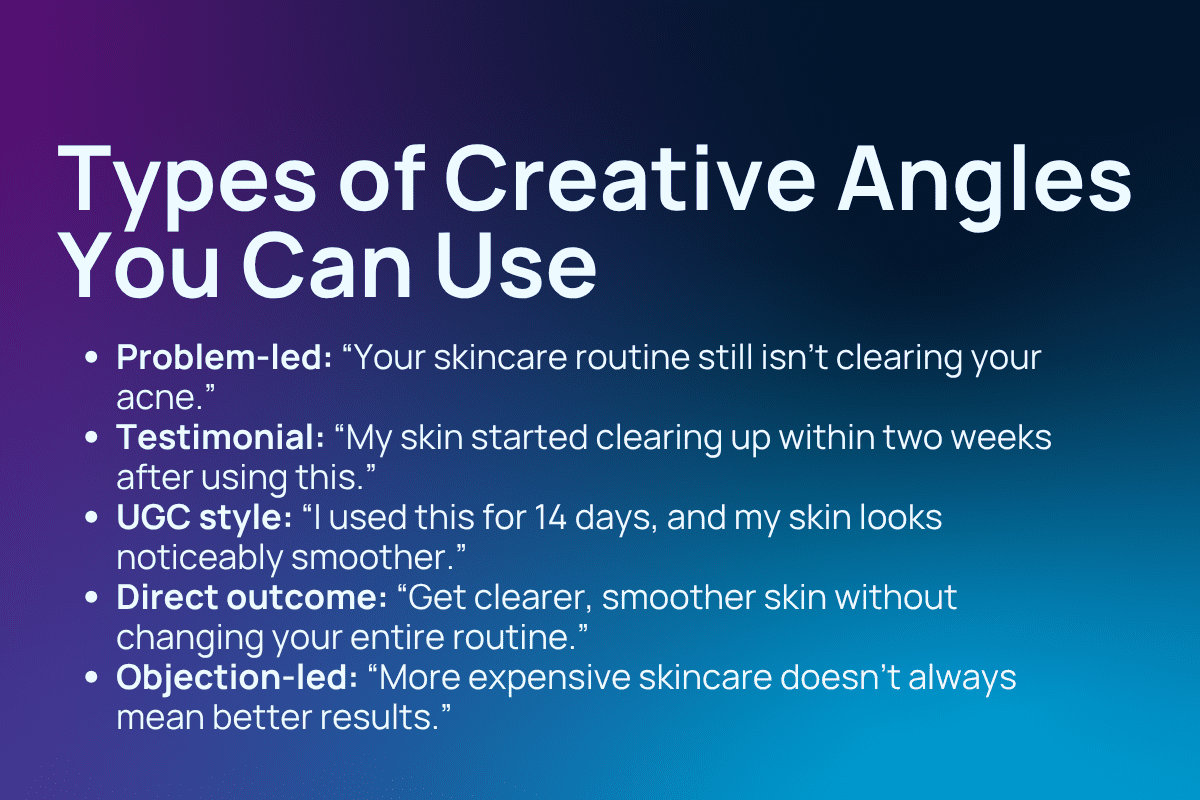
Think in terms of angles rather than variations, since one offer can produce multiple concepts that speak to different mindsets:
Each angle connects with a different perspective, which gives the algorithm more room to test and identify where engagement comes from.
Consistency in output supports stability. Aim for 10–20 new concepts per month so creative production remains a continuous input. This reduces the risk of performance decline caused by overexposure.
Over time, frequency and time-in-market show when a concept begins to lose effectiveness. As the same creative runs for extended periods, engagement drops and costs rise, even when other factors remain unchanged. Introducing new concepts refreshes attention and restores signal flow.
Use controlled testing to understand what drives results. Keep the offer, audience, and landing page consistent, and change only the concept so performance differences are easier to interpret.
Example structure:
- Same product
- Same audience
- Same landing page
- 5 different concepts launched together
This setup reveals which angle captures attention and which one converts. Relying on a single high-performing creative limits stability, as performance declines with repeated exposure. Rotating multiple concepts maintains consistency and reduces dependence on one asset.
Consolidate to Exit the "Learning Phase"
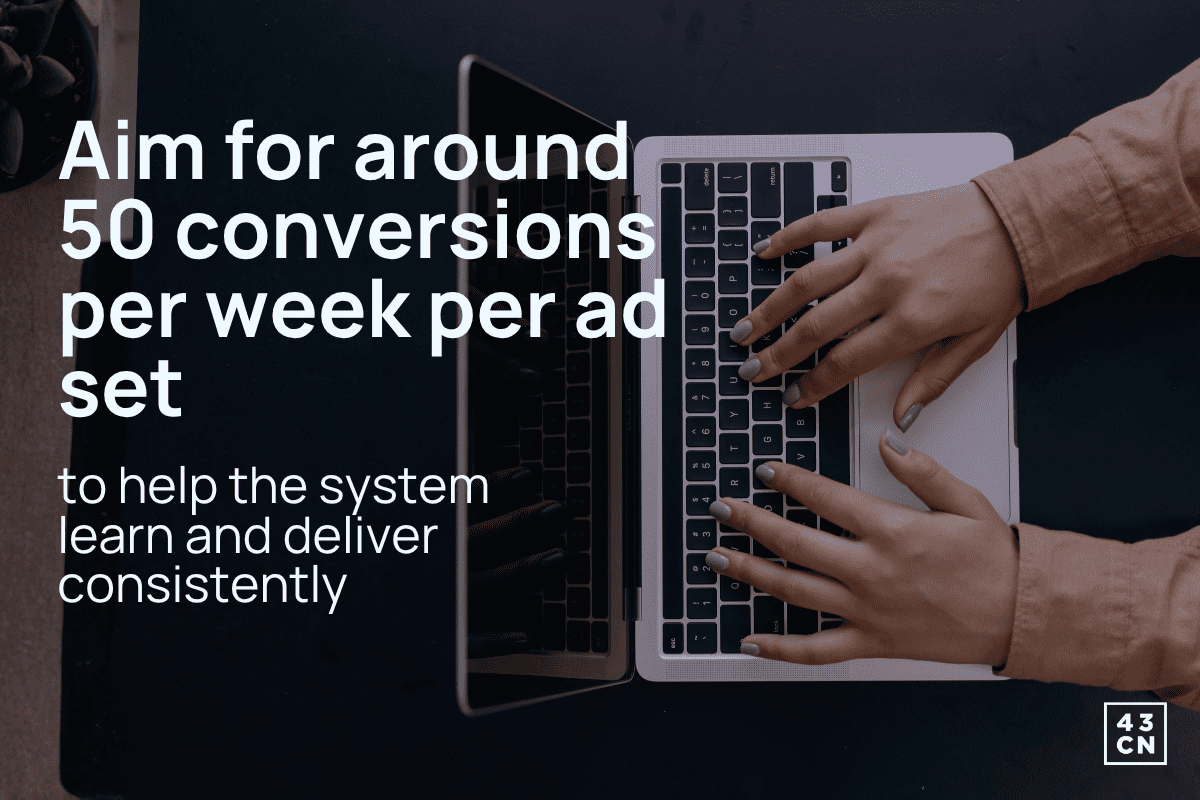
The algorithm relies on sufficient data within each ad set to learn and optimise delivery. When budgets and conversions are spread across too many ad sets, each one gathers limited data, which keeps performance unstable and delays optimisation.
This gives the algorithm enough signals to understand who is most likely to convert and where to spend the budget more efficiently. When conversion volume is too low, the system struggles to find patterns, which leads to unstable delivery and inconsistent results. This becomes difficult when your data is spread too thin.
Fragmentation often causes this. A £100/day budget split across five ad sets gives each only £20/day, which limits how much data each one can collect and keeps them stuck in learning. If you run a £100/day across one or two ad sets increases conversion volume per ad set, which supports more stable optimisation. Broader targeting within fewer ad sets also gives the algorithm more flexibility to identify high-performing segments without restriction.
When conversion volume is low, shifting the optimisation event higher in the funnel increases the number of signals and helps the system learn faster. These higher funnel events happen more often, which gives the system more data and helps stabilise delivery. Once you have enough volume, you can move back to deeper conversion events.
Example:
- 10 purchases per week, not enough for stable learning
- Switch to Add to Basket, 60 events per week, more stable optimisation
- Gradually return to Purchase once volume supports it
Keep changes controlled so the system retains its learning. Large or frequent edits reset the learning phase and remove accumulated data. Group updates where possible and allow time for the system to adjust before introducing further changes.
Implement the "Qualified Signal Framework"
Performance improves when conversions reflect what a qualified user actually looks like. This can include factors such as budget, timeline, role, or needs that align with your offer.
Introduce simple screening within your form to capture this information:
- “What’s your monthly budget?”
- “When are you planning to start?”
- “Are you the decision-maker?”
These inputs help you to separate users based on intent. Once responses are collected, direct users to different outcomes:
- Unqualified → general thank-you page
- Qualified → separate thank-you page
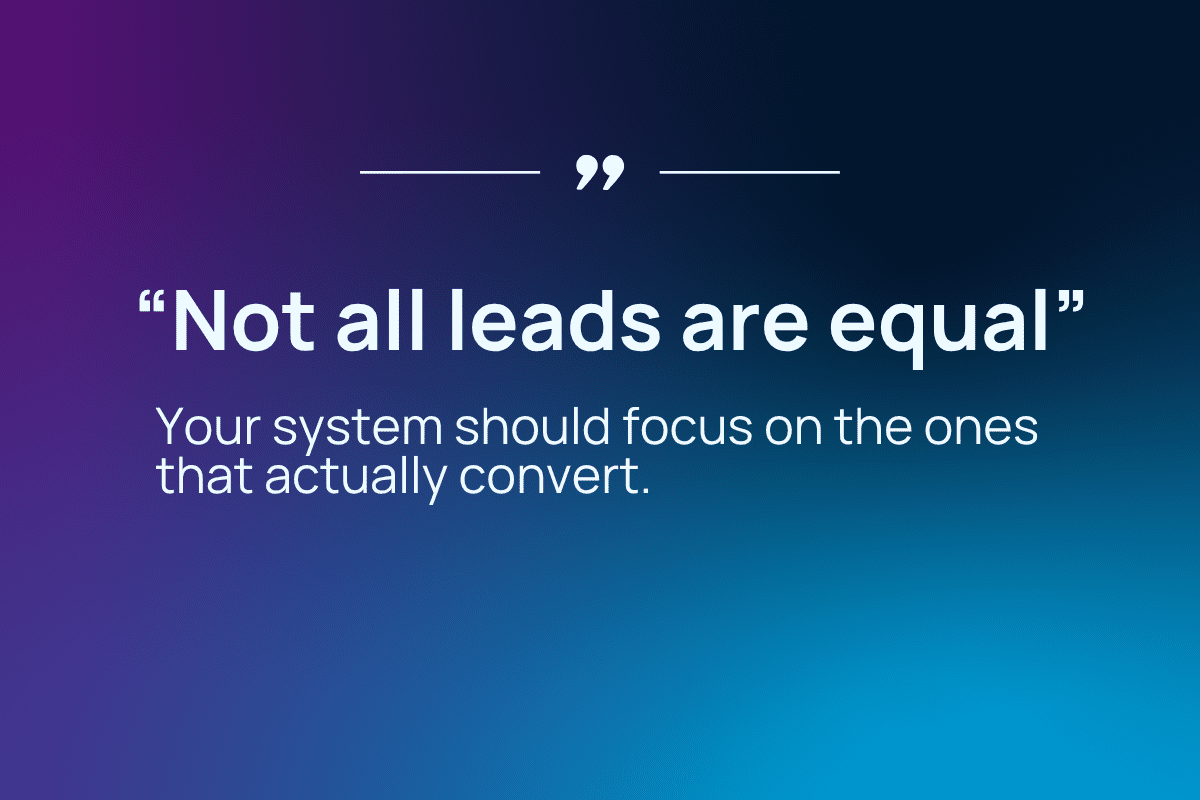
Trigger the conversion event only on the qualified thank-you page. This guides the algorithm towards users who match your ideal customer profile rather than treating all leads equally.
For example, if 100 leads come in and only 30 meet your criteria, tracking all 100 as conversions mixes high- and low-intent signals. Tracking only the 30 qualified leads focuses the system on patterns that lead to actual customers.
Eventually, this improves signal quality and aligns performance with business outcomes, leading to:
- Higher conversion rates further down the funnel
- More stable cost per qualified lead
- Stronger alignment between ad performance and revenue
Keep the filtering process simple so completion rates remain steady and signal flow stays consistent. A small number of well-chosen questions provides enough structure without limiting volume.
Bridge Technical Data Gaps
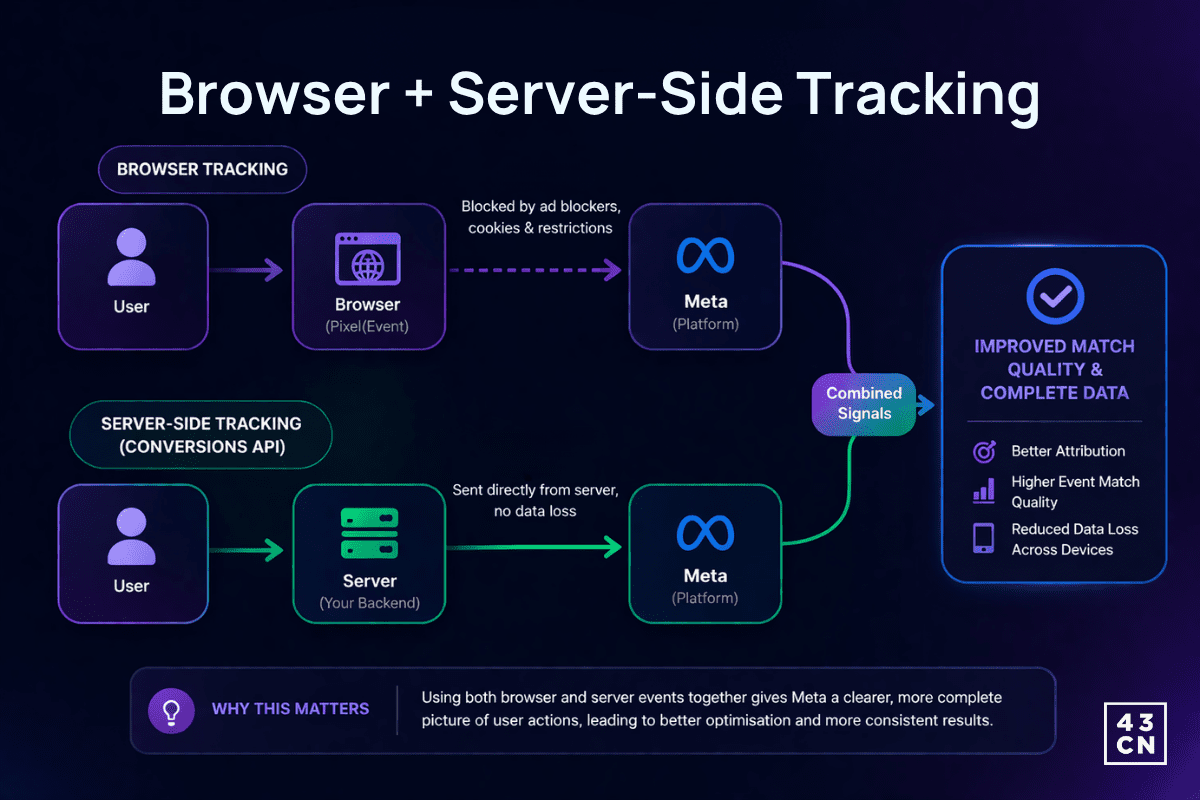
Signal loss is often the starting point. Browser restrictions, ad blockers, and cookie limitations prevent events from firing, which creates a gap between actual activity and what the platform records.
Server-side tracking through the Conversions API helps close this gap. Events are sent directly from your server rather than relying only on the browser, which restores missing data and improves visibility.
Using both browser and server events together strengthens event match quality and reduces data loss across devices.
Automatic Advanced Matching in Events Manager supports this further. It captures hashed identifiers such as email or phone number from your site and connects them to user profiles, which improves attribution and helps the system understand who is converting.
To set this up:
- Go to Events Manager
- Click the Data Sources icon on the left
- Select your data source (name and ID)
- Open the Settings tab
- Under Automatic Advanced Matching, toggle it ON
- Click “Show customer information parameters.”
- Toggle ON the parameters you want to share (at minimum, Email and Phone Number for better results)
Once set up, it can take up to 48 hours for results to appear in Events Manager.
Regular reconciliation also keeps tracking aligned with reality. Compare platform data with your backend systems, such as Shopify, your CRM, or your database. Gaps between these sources usually point to tracking issues rather than performance problems.
With accurate data in place, scaling becomes more predictable. Budget increases work best in gradual steps, around 10–25% every few days, so the system can adjust without disrupting what it has already learned.
Case Study on Attention Breakdown: Anonymous Learning Provider
One of our clients, an online learning provider, came to us with declining Meta performance that initially looked like a traffic issue. Delivery metrics were stable, such as CPM, reach, and spend, which were consistent, but results kept dropping.
After reviewing the account, we found that the ad spending was going into a single creative that had been running for more than 10 months. The messaging hadn’t changed, and the ad had simply worn out. Users weren’t reacting anymore, which meant the algorithm had fewer signals to optimise from.
The impact showed up quickly:
- Contact rate dropped by 40%
- ROAS declined by 60%
- CPL became unstable
Instead of targeting or budgets, we focused on fixing the attention gap through creatives. We introduced multiple new concepts within a few weeks, each built on a different angle:
- Problem-led hooks around career stagnation
- Testimonial-style creatives
- UGC-style videos
- More direct, outcome-focused messaging
At the same time, we reduced reliance on a single “winner” and allowed multiple creatives to gather data. The results followed a clear sequence. Engagement improved first, then signal quality, and finally efficiency. Within 6–8 weeks, CTR increased, CPL stabilised, and performance became predictable again.
This case reinforced a simple pattern: when delivery is stable, but results decline, the issue is often attention. Once we rebuilt engagement through creative diversity, performance recovered without changing the account structure.
Strategic Frameworks for Long-Term Stability
To ensure long-term stability and prevent recurring performance cliffs, you must move beyond temporary tactics and implement high-level strategic frameworks. These systems align the ad account's behaviour with the actual business reality and the platform’s modern AI requirements.
1. The Product Stage Framework
One of the most common reasons for sustained performance dips is using the wrong playbook for where a product actually sits in its lifecycle.
- Early Phase (Testing): At this stage, stop obsessing over immediate ROAS. The goal is signal quality: Identifying which angles get a real response and if people are adding to the cart.
- Growth Phase (Scaling): The risk here is mishandling momentum. Focus on creative refresh rates and ensuring budget increases don't outpace the system’s ability to learn.
- Maturity Phase (Saturation): When cold traffic stops behaving like it used to, stop blaming the creative alone. Shift focus toward protecting efficiency, marginal acquisition costs, and audience segmentation.
- Decline Phase (Harvesting): Be honest when demand is fading. Move from growth mode to harvesting existing demand and diverting budget to newer opportunities.
Understanding which stage your product is in helps you to apply the right strategy, maintain signal quality, and avoid misinterpreting performance changes.
2. The Continuous Creative Engine
In the Andromeda retrieval system, creative variety is no longer a one-time task but a permanent marketing discipline.
- The 2–4 Week Refresh Cycle: Establish a system to introduce new creative concepts every two to four weeks. This prevents the sharp performance drops associated with creative fatigue, where audiences stop responding because they’ve seen an ad too many times.
- True Creative Diversity: Success requires testing 3–5 completely different concepts weekly, rather than just minor variations or "reskins" of one idea.
- Angle Testing: Rotate between diverse psychological triggers, such as emotional hooks (e.g., pain points), social proof (e.g., "400,000 customers trust us"), and seasonal urgency.
A continuous creative engine gives the system more entry points to explore, supports consistent signal flow, and maintains performance as audience exposure increases.
3. The Qualified Signal Framework
Long-term stability is only possible if you are training the algorithm on high-intent data rather than just volume.
- Separate the Signal: Use screening questions to filter users instead of treating every lead submission as a success.
- Selective Firing: Only fire your conversion event for "qualified" leads (e.g., those with the right budget or timeline). This ensures Meta's AI optimises for actual buyers rather than "browsers," preventing the system from spiraling into a loop of low-intent traffic.
- Data Reconciliation: Before making major strategy shifts, perform a manual reconciliation between your backend data and Meta’s reporting to ensure your stage diagnosis is based on accurate tracking.
Having a clear and consistent signal framework improves optimisation quality and keeps performance aligned with actual business results.
Winning on Meta
Success on Meta comes down to the disciplined, often repetitive work of making better creative, deeply understanding your customers, and refining your product and website experience. While "hacks" are temporary, a consistent marketing discipline is what builds long-term stability.
Creative remains the primary engine of your performance. No amount of budget manipulation or targeting tweaks can save a campaign with broken or stale visuals. To stay ahead of the attention gap, you must treat creative development as an ongoing investment, moving away from reactive "remote control" adjustments toward repeatable systems that scale predictably.
At 43 Clicks North, we build Meta accounts around consistency, clear signals, and scalable creative systems. If your results become unstable each time you increase spending, the issue often sits in the foundation. Reach out, and let’s get your system working the way it should.
Stopped growing online?
We know how to fix that.
We start with your data, not your channels.
Commercial, market, performance, customer and behavioural data, woven into one view rather than five separate reports.
It shows where your profit comes from, which activities earn their place, which are dead weight, and what's worth doing next.
We typically find 15-30% in wasted marketing spend in the first 3 months.
Channels are the tools; making your business more money is the objective.
Latest News
See all
5 Conversion Blockers That Hurt Black Friday Sales
Shoppers are ready to buy this season, but site blockers can send them to competitors. Discover 5 mistakes to avoid and how to fix them.


5 Strategies to Boost Ecommerce Landing Page Conversions
Your ecommerce landing page is critical in the success of your online store. Join 43 Clicks North as we share our tips on boosting your conversion rates.

How building/nurturing communities can benefit your brand
One of the most enigmatic marketing strategies, has always been communities. Find out how building & nurturing communities can benefit your brand with 43CN.