
How much is AI actually used in marketing?
.jpg)

At the beginning of 2023 AI leapt to the forefront of tech media with the rollout of ChatGPT to the public. Everyone seemed to be questioning whether AI would be the downfall of humanity.
With fears that AI would take over and perform tasks in seconds that takes a human hours, days or weeks to complete, how are things looking now that the initial buzz has settled?
Here are some top-level stats:
- Over 80% of executives in the retail and consumer space expect their businesses to use AI automation by 2025
- 66% of businesses are using or planning to use AI for their sustainability goals
- 71.2% believe AI can outperform humans at their jobs
Share it with friends
What do we class as 'AI used in marketing?'
This is a powerful question for me. When we talk about AI being used in marketing a lot of people immediately think of creative, strategy or data analysis / code assumptions.
The fear is that companies like MidJourney will eradicate graphic designers and creative studios. Or that you can ask ChatGPT to code you a website/application and boom, job done. Easy peasy, no further action required and if there is, AI will have a solution.
But this just isn’t the case.
AI has actually been around for years before the boom in 2023 where it became more publicly accessible. Some common examples of this include:
- Automating spend for paid accounts (Google Ads, Facebook, etc.)
- Creating cold audiences based on matching characteristics
- NLP (neuro linguistic programming)
- BERT (understanding word context and user intent)
- Chatbots or auto-response chat features
- Search Engine Results (Google, Bing etc.)
When Influencer Marketing Hub performed a survey in 2023, it showed high engagement for people testing out AI in their marketing campaigns.
From an outsider looking in at this AI boom, this felt like a tech rat race. A monumental milestone that would radically change the landscape of marketing. So it’s no surprise that people were testing different ways to use AI in their marketing strategy and the percentages are high.
(from Influencer Marketing Hub 2023)
- 61.4% of marketers have used AI in their marketing activities
- 44.4% have used AI for content production
- 71.2% believe AI can outperform humans at their jobs
So people started using it to write articles and various forms of content, from metadata to ad copy, to keyword research and setting cross-channel strategies, using AI to achieve higher results than ever before… right?
Well, not quite. Below is a comparison from 2021 to 2022 showing percentage changes in where AI is being used. This shows that the core use for AI is for email marketing (55%), social media management (44%) and paid ads (26%). SEO remained static year over year at 18%.
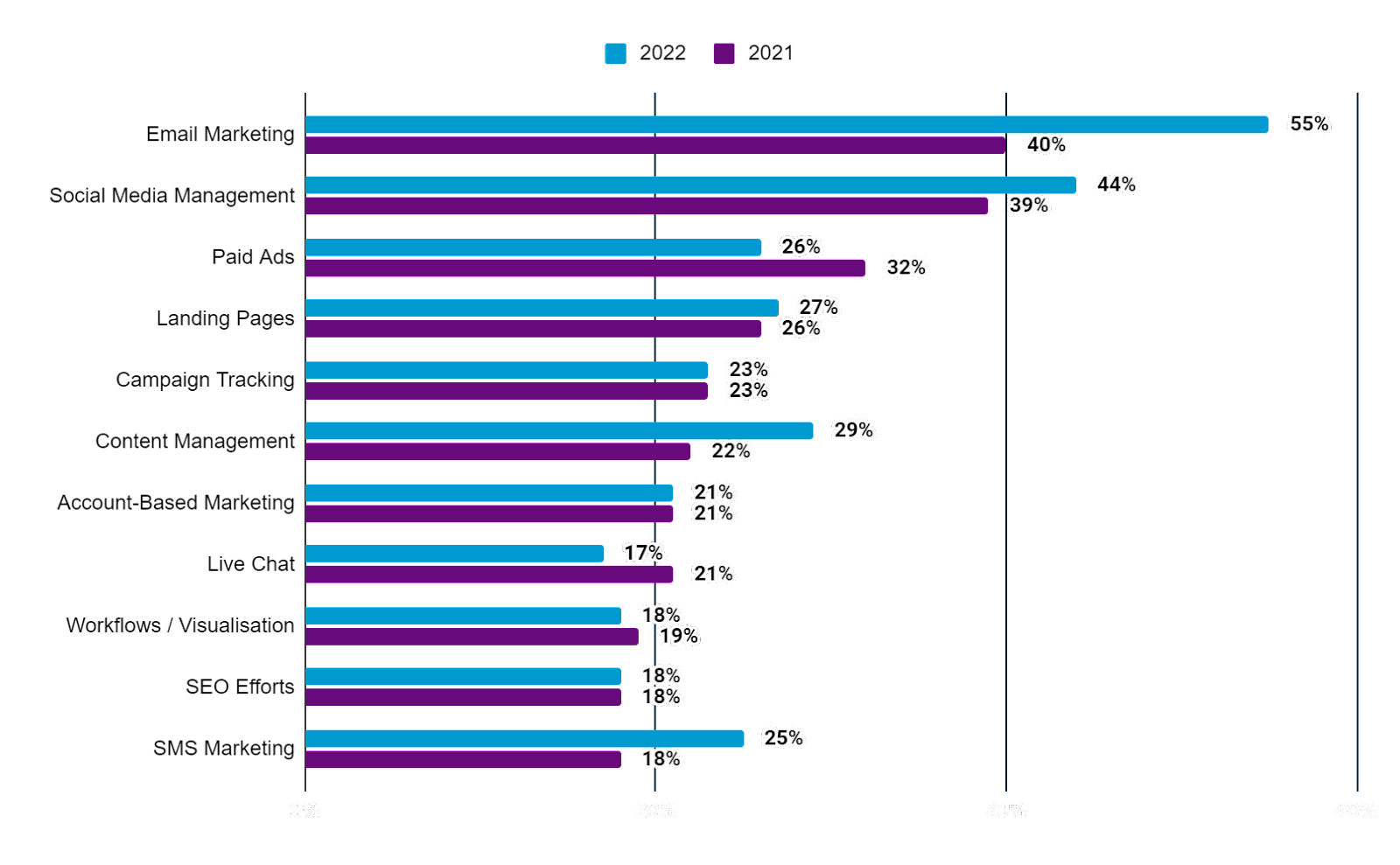
In which of the following areas do you currently utilise marketing automation?
It’s hard to find much survey data for AI used in 2023 as there hasn’t been enough time for case studies and data to be implemented, tested and reported on. Hopefully, we will get insights on this soon to be able to determine how things have changed.
A 2022 report from Ascend2 quizzed just under 400 businesses of varying sizes and positions on their use of AI with automated marketing.
It found that AI was being heavily utilised in both paid advertising and email marketing at 32% each, followed by product content at 22% and more email messaging (22%).
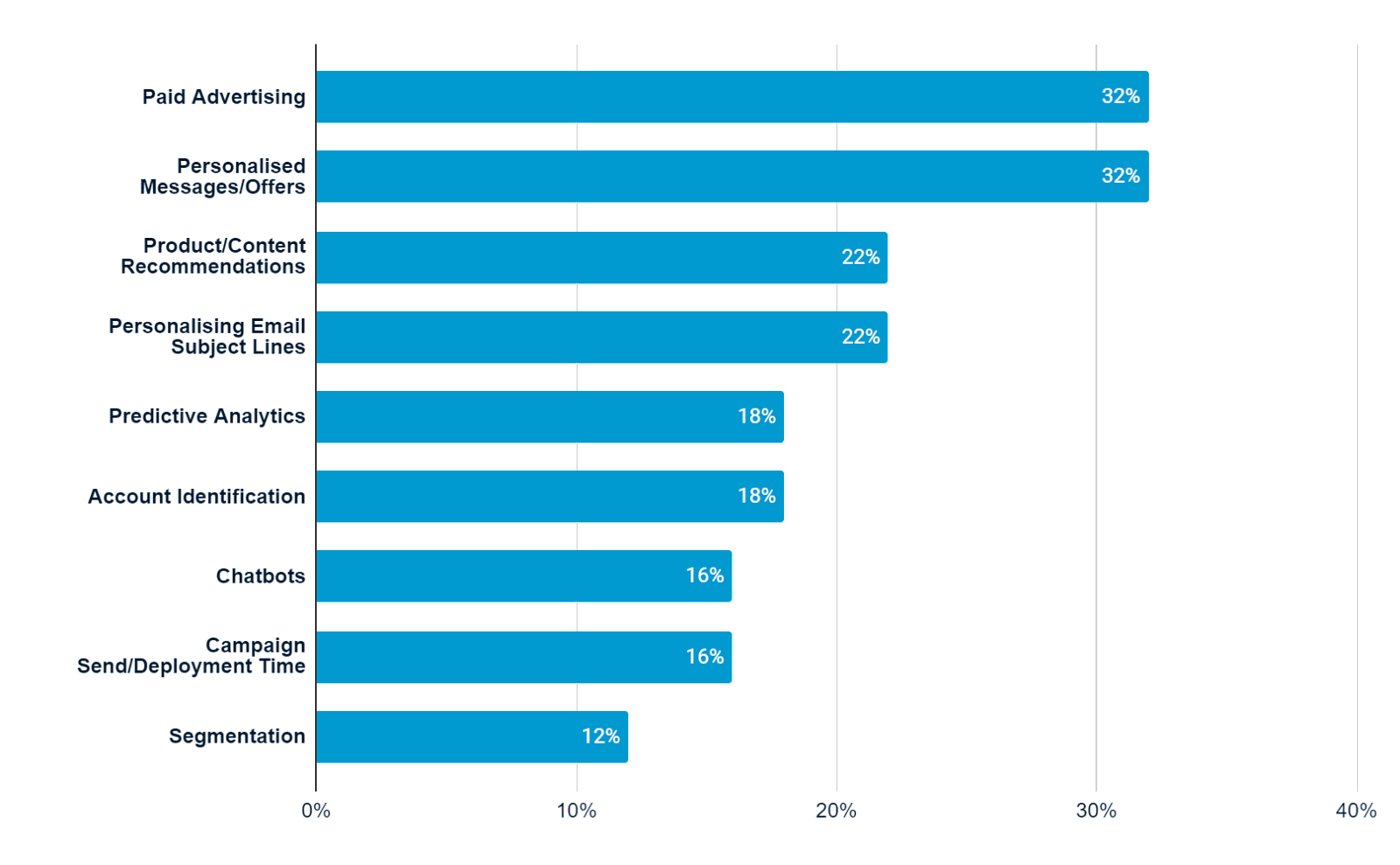
In which areas are you currently testing or utilising the use of AI in conjunction with your marketing automation?
This data helps soothe the panic people are feeling about not utilising AI or feeling like they are falling behind. In reality, most uses of AI are for paid bid adjustment and automating spend within ad management platforms, or creating sales messages for email marketing campaigns.
In this survey, people were also asked to rate the success of AI automation in achieving important marketing goals. Overall, 64% said it was somewhat successful, 14% said it was unsuccessful and only 22% classed it as very successful.
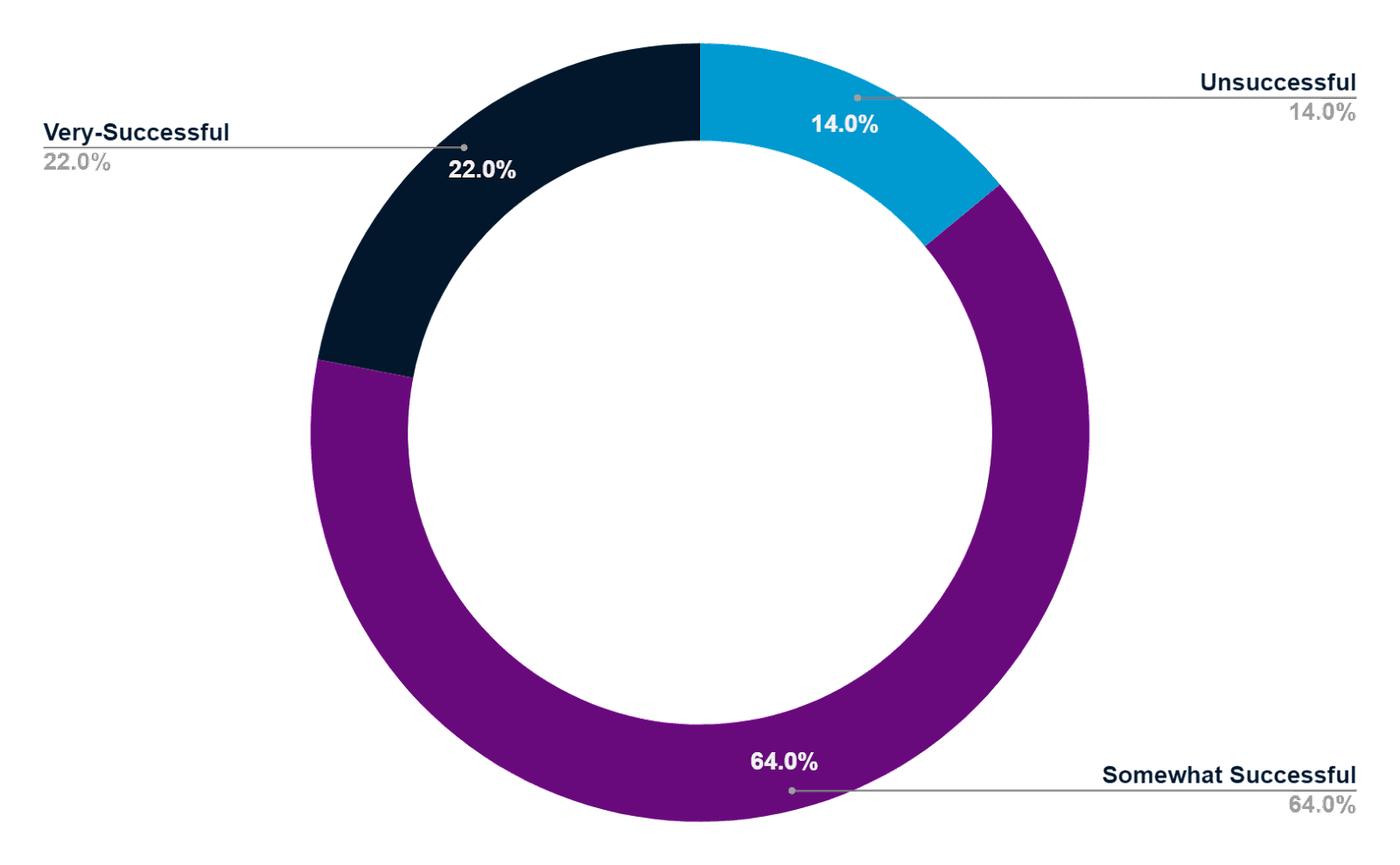
How would you rate the success of your marketing automation at achieving important marketing objectives?
This signifies that although AI can be used in marketing campaigns, it’s a long way from perfect. You can’t just flip a proverbial switch and expect it to do everything for you.
For me, the data says the opposite. AI integration still needs work and to be tested and tweaked in its application to get the balance just right. Learning how to properly utilise AI to achieve performance takes more time and testing than people lead you to believe. The reality is that in the time you will need to take to learn the ‘right way’ to implement AI into your strategies you could probably manually achieve the same results.
Use of AI by job function
An IBM survey in 2022 shows that the main areas in business where AI is being used are IT professionals (54%), Data Engineers (35%) and Development and Data Science (29%).
(from IBM 2022)
- 54% IT professionals
- 35% Data engineers
- 29% Developers and data scientists
- 26% Security professionals
- 25% Customer service professionals
- 23% Marketing professionals
Only 23% of AI is used in marketing, and we know from the graph above that a large portion of this is used in customer analysis to generate new audiences, content creation (both written and visual), keyword research or data analysis and lastly, chatbots or some form of customer response within that 23% portion
So outside of paid, emails, social ads, code checking, content and image creation there is a very small percentage of AI used to dictate or control marketing strategies.
In reality, there is a very small percentage of people in marketing using AI outside of the current conventions mentioned above.
What’s hindering/driving AI adoption?
According to the same IBM survey in 2022 these are the top 5 reasons that hinder AI from being more widely adopted:
(IBM 2022)
- Limited AI skills, expertise or knowledge (34%),
- Price is too high (29%),
- Lack of tools or platforms to develop models (25%),
- Projects are too complex or difficult to integrate and scale (24%),
- Too much data complexity (24%).
We have seen that AI is being used to varying degrees in marketing and other business types, but a large blocker is limited AI knowledge or understanding of how to apply it effectively to the task at hand. This is where you can spend hours testing prompts and different commands to achieve your goals. This can be off-putting.
The price of some solutions also feeds into the narrative that AI is another commodity for a small number of users who have the resources to capitalise on it.
There is a crucial point that is missing from this list: the trustworthiness of AI.
I’ve seen lots of examples from marketing experts and SEO industry leaders who have highlighted examples of AI providing misinformation, or the query intent not matching the results shown in search.
One example is from Lily Ray who found Google’s SGE pulling incorrect pages into an AI-rich result and stating that a shop sold a product they did not sell.
While this isn’t going to make everybody suddenly stop and question AI integrity, it is an example of how AI can get things wrong and could be exposed to biased information which could be used negatively to; influence political campaigns, mislead users online to buy products under false pretence, or provide inaccurate health advice for financial profiteering.
CNET wrote an article about AI misinformation and ways it can be misused, but we know from recent updates and changes to search that Google prides itself on user security (spam updates), providing accurate, trusted information (E-E-A-T) and being an authority service that looks after its users.
How do I see AI being used for SEO?
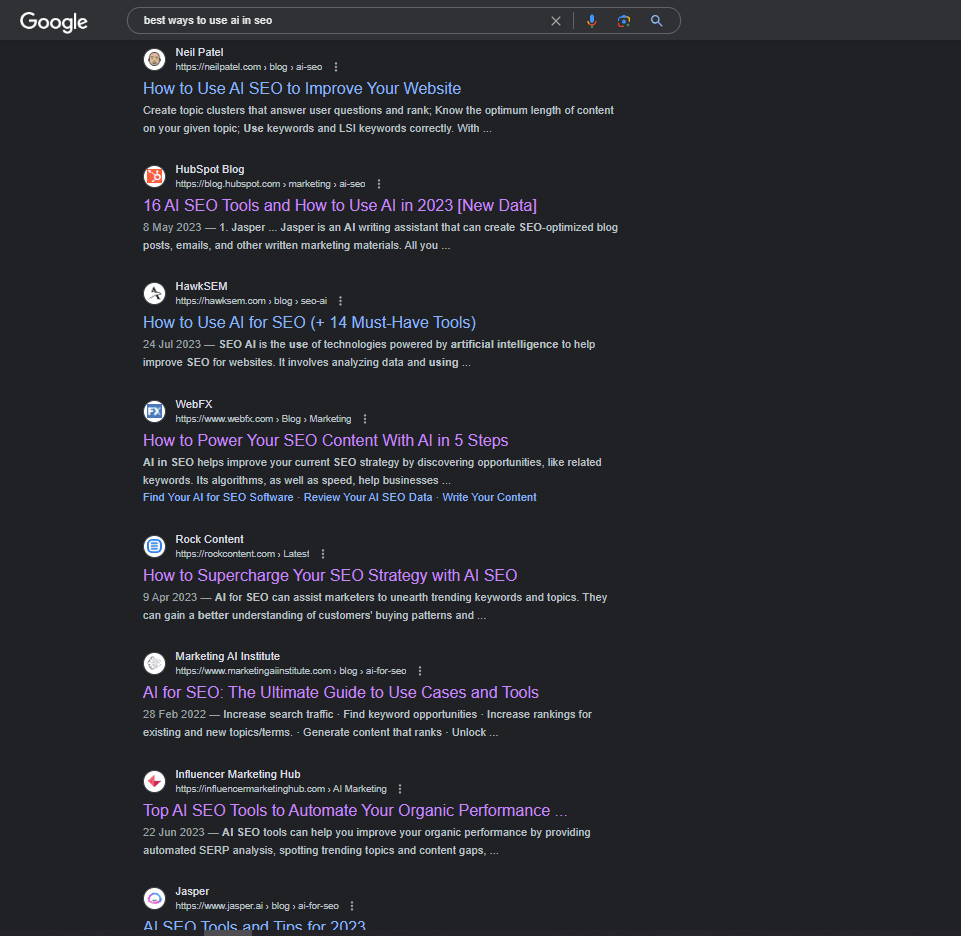
While researching AI and performing multiple AI-related search queries, I found it increasingly difficult to find any real evidence or strategy-led data to showcase someone using AI to automate SEO (outside of the tools like keyword research, content writing, data analysis etc.).
This could be due to AI not being around long enough for marketers to utilise and analyse strong enough data sets to provide solid arguments, but it struck me as something else.
When searching for 'how to use AI in SEO' or 'automate SEO with AI' or any combo of ‘AI’ + ‘SEO’ all I found was articles. These articles were lists of ‘best AI tools for SEO’ or ‘Top 10 AI tools for SEO 2023’ and just rehashed the same 15-20 AI-based platforms that help with:
- Keyword Research
- Writing Content
- Data analysis
- Image generation
- On-page/content analysis
- Ad automation
- Etc.
This shows to me that AI (for the time being) is being used to create more software and tools that already exist but perform tasks in a new way (faster and with less input / manual action).
I found that a lot of the free AI tools have limitations which means they can’t be used at scale or are limited in their free format which prevents them from being used to achieve ‘world domination’.
If you want to experience the best AI software out there, then you typically have to pay. Whether it be subscription or token-based currency, the top AI tools have a price tag which for me, stops them from being a tool to automate boring repetitive tasks and bring salvation to an overworked and tired labour force. Instead it makes them another commodity tool used for a specific purpose.
Is AI taking over SEO and being used to set strategies?
One thing is certain. AI is a part of marketing and isn’t going to go away anytime soon. In fact, I would say that AI will continue to be integrated into businesses as the technology advances and becomes more of an industry standard.
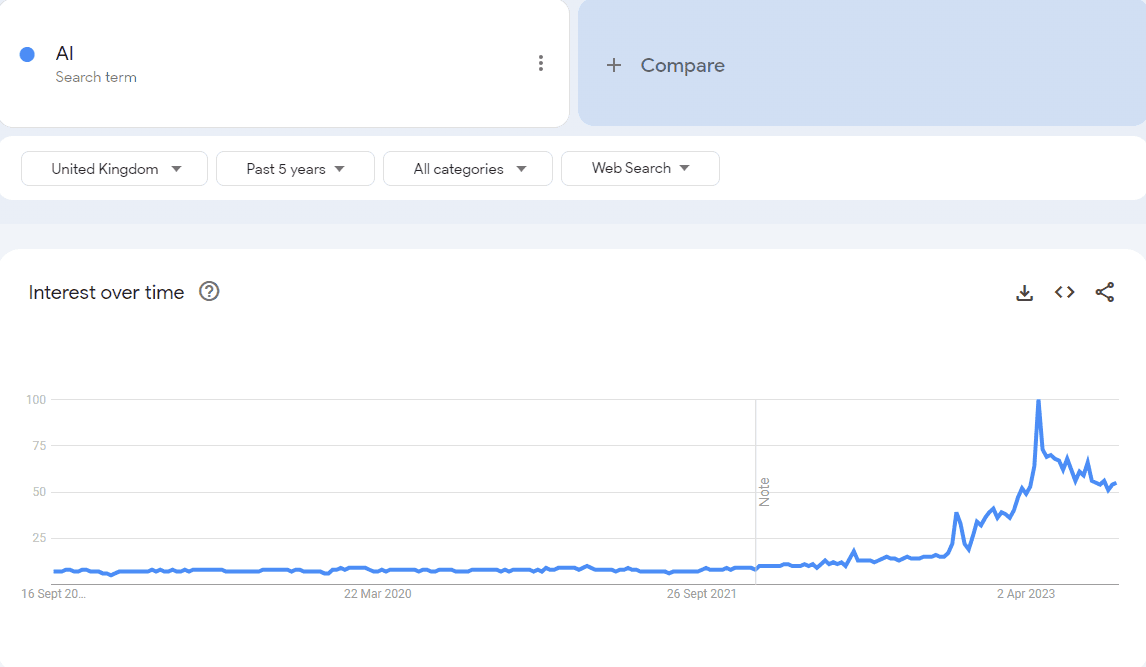
This being said, according to Google Trends over 5 years the term ‘AI’ is showing a -50% drop in demand since the initial spike in April 2023.
While it can feel like everyone is using AI and you are missing out and being left behind, the reality is that most AI is being used to automate tasks that are already automated in lots of ways. The number of people using it to guide strategies is very small and the success rate is even smaller.
We are far away from giving an AI tool a URL and some prompts like 'set me a 12-month strategy focusing on increasing organic visibility by +20% and boost conversion rate to 5%'. Achieving performance like this will still need a human to interlink all the driving factors, identify areas of opportunity and implement changes to achieve core KPIs.
AI will continue to evolve in the industry and I hope to see it alleviate BAU and repetitive tasks from marketers so they are more free to explore and experiment with new strategies. However, it is always good to keep your tools sharp and not rely on AI to do everything for you.
References
- https://www.webfx.com/blog/marketing/ai-statistics/
- https://martech.org/ai-and-marketing-what-the-stats-show/
- https://ascend2.com/wp-content/uploads/2022/02/The-State-of-Marketing-Automation-2022-220226.pdf
- https://influencermarketinghub.com/ai-marketing-statistics/
- https://www.forbes.com/sites/forbesagencycouncil/2023/04/19/how-ai-will-revolutionize-the-future-of-seo/
- https://www.semrush.com/blog/artificial-intelligence-stats/
Stopped growing online?
We know how to fix that.
We start with your data, not your channels.
Commercial, market, performance, customer and behavioural data, woven into one view rather than five separate reports.
It shows where your profit comes from, which activities earn their place, which are dead weight, and what's worth doing next.
We typically find 15-30% in wasted marketing spend in the first 3 months.
Channels are the tools; making your business more money is the objective.
Latest News
See all
5 Conversion Blockers That Hurt Black Friday Sales
Shoppers are ready to buy this season, but site blockers can send them to competitors. Discover 5 mistakes to avoid and how to fix them.


5 Strategies to Boost Ecommerce Landing Page Conversions
Your ecommerce landing page is critical in the success of your online store. Join 43 Clicks North as we share our tips on boosting your conversion rates.

How building/nurturing communities can benefit your brand
One of the most enigmatic marketing strategies, has always been communities. Find out how building & nurturing communities can benefit your brand with 43CN.