
How Andromeda Changed Meta Ads


If you run e-commerce or B2C lead generation campaigns on Meta, performance may feel tighter than it did a few years ago.
You might notice patterns like:
- One ad quickly absorbing most of the budget
- CPA or CPL increasing faster when you scale
- Creative performance declining sooner than expected
- New ads struggling to gain meaningful delivery
This shift isn’t random. It reflects changes to Meta’s ad delivery infrastructure through its AI-driven system called Andromeda.
Instead of distributing budget broadly across many creatives for longer periods, the system now builds confidence around clear behavioural signals much faster. Once a strong signal appears, delivery concentrates around that pathway.
This makes accounts feel more directional earlier in the campaign lifecycle. It also means accounts that rely on one dominant motivation or message can become fragile when scaling.
Understanding how this works helps advertisers structure campaigns in a way that creates multiple stable pathways for growth instead of one saturated stream.
Structure Campaigns Around Different Buying Reasons
Supporting Image: Example diagram showing multiple concept pathways vs one dominant pathway
Under Andromeda, creative diversity only matters if it represents different motivations for buying.
If several ads promote the same underlying idea, the platform groups them into a single behavioural pathway. The strongest execution absorbs most of the delivery, and the rest reinforce the same signal rather than creating new expansion routes.
How to Achieve
Start by defining distinct buying motivations before producing creative.
For example, an e-commerce supplement brand might structure campaigns like this:
- Concept A: Faster recovery for athletes
- Concept B: Daily energy for busy professionals
- Concept C: Long-term health optimisation
Each concept attracts different behavioural signals and user motivations.
In B2C lead generation, a home improvement company might structure messaging around:
- Lower monthly energy bills
- Increased property value
- Lifestyle comfort upgrades
When concepts appeal to different motivations, the platform can build confidence around multiple behavioural clusters instead of one.
This makes scaling more stable because growth doesn’t rely on a single audience pathway.
Common Mistakes
Many advertisers believe creative variation automatically creates diversification. In reality, most variations repeat the same underlying motivation.
Common mistakes include:
- Producing multiple creatives that all promote the same discount
- Changing visuals or formats without changing the buying reason
- Launching many ads with the same “Free Consultation” promise
Even if visuals differ, the system still sees one core motivation. As a result, delivery consolidates around one execution and the rest struggle to gain traction.
Separate Concepts So Meta Can Learn Clearly
Supporting Image: Diagram showing mixed signals vs isolated campaign concepts
Clear signal structure helps Meta understand which motivations drive results.
If several buying reasons are placed in the same ad set or campaign, behavioural signals blend together. Stronger pathways quickly absorb delivery before other concepts gather enough data to prove their potential.
How to Achieve
Structure campaigns so each core concept runs independently.
For example:
Instead of running three motivational angles inside one campaign, create separate campaign groups aligned to each intent.
This allows each concept to:
- gather its own behavioural data
- build predictive confidence independently
- compete fairly during the learning phase
Budget allocation also matters. Each concept needs enough spend to generate meaningful conversion signals before performance decisions are made.
Parallel learning gives the system a chance to identify multiple high-confidence pathways, not just one dominant stream.
Common Mistakes
Poor campaign structure often creates the appearance of testing while preventing real learning.
Common mistakes include:
- Placing multiple concepts in the same ad set
- Allowing one early performer to absorb most of the budget
- Shutting down concepts before enough data is collected
When signals mix together, Meta’s delivery system naturally reinforces whichever pathway shows early promise. Other concepts never receive enough exposure to prove their potential.
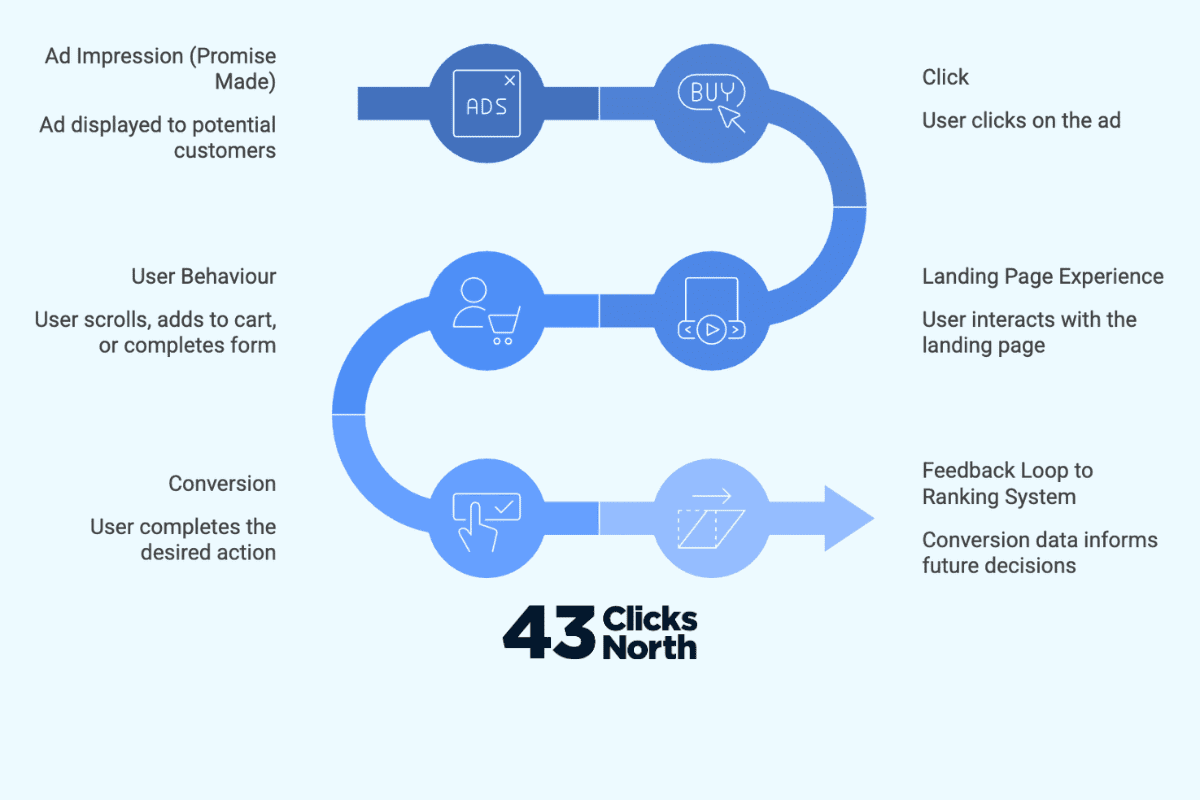
Align the Post-Click Experience With the Ad Promise
Supporting Image: Expectation pathway diagram showing impression → click → behaviour → conversion
Under Andromeda, engagement alone isn’t enough. The platform evaluates what happens after the click to determine whether delivery should expand.
If user behaviour after the click follows a consistent pattern, the system gains confidence and retrieves similar users more often. If behaviour fragments, delivery becomes narrower.
How to Achieve
Ensure the landing page experience continues the expectation created in the ad.
For example:
If an ad emphasises speed, the landing page should highlight fast results immediately and simplify the path to conversion.
If the ad promotes premium quality, the landing page should focus on proof, credibility, and product detail.
In lead generation campaigns, the form structure should also match the promise:
- “Quick consultation” should lead to a short, simple form
- “Detailed strategy review” can justify requesting more information
This alignment keeps behaviour structured and predictable.
When users move naturally from impression to conversion, Meta’s system builds stronger confidence around that pathway and expands delivery.
Common Mistakes
Post-click mismatches are a common source of performance instability.
Typical issues include:
- Ads promising quick solutions but sending users to long forms
- Messaging that changes dramatically after the click
- Landing pages that introduce friction or confusion
When behaviour becomes inconsistent, the system limits expansion and concentrates delivery on smaller pockets of reliable converters.
Andromeda Rewards Clear Signals, Not Just More Creative
Andromeda didn’t simply change how ads are delivered. It changed how quickly the system builds confidence around behavioural signals.
That’s why many advertisers now see:
- one ad absorbing most of the budget
- scaling driving CPA or CPL up faster than expected
- creative fatigue appearing sooner
Producing more variations alone doesn’t solve this. If those variations promote the same buying reason, the platform treats them as one behavioural pathway.
Sustainable growth now comes from giving the system multiple clear motivations to learn from.
When campaigns are structured around distinct buying reasons, isolated signals, and aligned post-click experiences, Meta’s delivery engine can expand more predictably and scale more efficiently.
Stopped growing online?
We know how to fix that.
We start with your data, not your channels.
Commercial, market, performance, customer and behavioural data, woven into one view rather than five separate reports.
It shows where your profit comes from, which activities earn their place, which are dead weight, and what's worth doing next.
We typically find 15-30% in wasted marketing spend in the first 3 months.
Channels are the tools; making your business more money is the objective.
Latest News
See all
5 Conversion Blockers That Hurt Black Friday Sales
Shoppers are ready to buy this season, but site blockers can send them to competitors. Discover 5 mistakes to avoid and how to fix them.


5 Strategies to Boost Ecommerce Landing Page Conversions
Your ecommerce landing page is critical in the success of your online store. Join 43 Clicks North as we share our tips on boosting your conversion rates.

How building/nurturing communities can benefit your brand
One of the most enigmatic marketing strategies, has always been communities. Find out how building & nurturing communities can benefit your brand with 43CN.