
Google’s Page Experience and Core Web Vitals: Updates and More Details on How To Optimise for SEO in 2021
.png)

We recently wrote a comprehensive guide on Google’s Core Web Vitals, which detailed what the update is focused on, factors to optimise for page speed, and the impact this will have in the industry. On Monday 19th April 2021, Google shared more details around the Page Experience updates and, it turns out, we hit the nail on the head!
In the announcement, Google confirmed that the Core Web Vitals update is being pushed back to mid-June. Google does not want to rush releasing this update and potentially disrupt the search results by rolling out before it is ready. It wouldn’t surprise me if the update is pushed back further still into the latter part of 2021, but for now, we’ll proceed with ‘mid-June’.
It has also been confirmed that the Core Web Vitals update will be introduced gradually rather than with a sudden algorithm change. Google compared it to adding flavours to a food you are preparing, saying:
“Rather than add the flavour all at once into the mix, we'll be slowly adding it all over this time period.” - Google Search Central
This means that there is still some wiggle room for you to improve the Core Web Vitals score before you start to see a potentially negative performance but I wouldn’t leave it any longer.
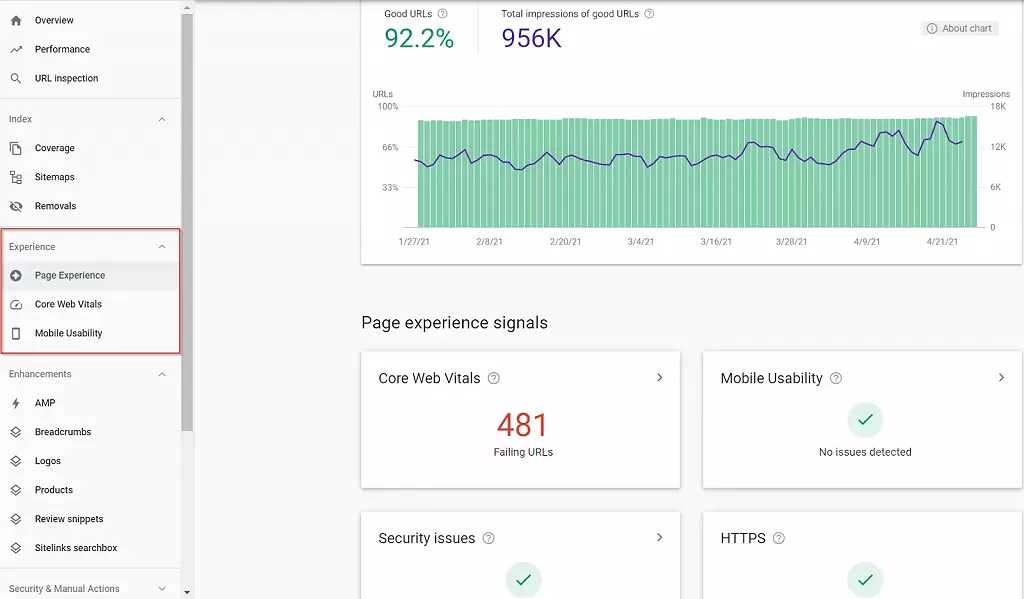
New Page Experience in Search Console To Help Analyse and Track Performance
One thing I like about Google is that when they introduce new factors into search, they provide resources, tools, and reading material that helps us to analyse and understand what the changes are.
Recently, Search Console has had a new ‘Experience’ section added to the sidebar which houses breakdowns of Core Web Vitals, Mobile Usability, and Page Experience.
We recently wrote a comprehensive guide on Google’s Core Web Vitals, which detailed what the update is focused on, factors to optimise for page speed, and the impact this will have in the industry. On Monday 19th April 2021, Google shared more details around the Page Experience updates and, it turns out, we hit the nail on the head!
In the announcement, Google confirmed that the Core Web Vitals update is being pushed back to mid-June. Google does not want to rush releasing this update and potentially disrupt the search results by rolling out before it is ready. It wouldn’t surprise me if the update is pushed back further still into the latter part of 2021, but for now, we’ll proceed with ‘mid-June’.
It has also been confirmed that the Core Web Vitals update will be introduced gradually rather than with a sudden algorithm change. Google compared it to adding flavours to a food you are preparing, saying:
“Rather than add the flavour all at once into the mix, we'll be slowly adding it all over this time period.” - Google Search Central
This means that there is still some wiggle room for you to improve the Core Web Vitals score before you start to see a potentially negative performance but I wouldn’t leave it any longer.
One thing I like about Google is that when they introduce new factors into search, they provide resources, tools, and reading material that helps us to analyse and understand what the changes are.
Recently, Search Console has had a new ‘Experience’ section added to the sidebar which houses breakdowns of Core Web Vitals, Mobile Usability, and Page Experience.
Signed Exchange: Google’s New Way To Optimise For Page Experience
What is a Signed Exchange (SXG)?
An SXG is a way to prefetch key resources by authenticating the resource origin prior to it being requested. Previously, only AMP results were able to utilise Signed Exchange. Now, however, both AMP and non-AMP results should be able to request critical resources (such as HTML, JavaScript, CSS, images, and fonts) earlier in the rendering process, in a privacy-preserving manner.
How SXG can Improve Page Experience?
This means websites that implement SXG could improve the Core Web Vitals score simply by having a lower Largest Contentful Paint (LCP) score for your content. While Google Search doesn't consider the use of SXG as a direct factor in ranking, the lower LCP may affect ranking because page experience will be a ranking factor.
What Impact can Implementing Signed Exchange have on SEO?
Verified testing using SXG on Android Chrome by a Japanese based site (Nikkei Style) saw a reduction in Largest Contentful Paint (LCP) by -300ms. This impacted other behavioural metrics, seeing user engagement increase by +12% and pageview by +9%. Therefore, not only is page speed a ranking factor, but it also correlates with engagement and click-through rate.
What Browsers Support SXG?
SXGs are supported by Chromium-based browsers starting with versions:
- Chrome 73
- Edge 79
- Opera 64 and above
Be sure to investigate what browsers and devices your users are on and factor this into your decision for implementation. If you want to learn more about implementing SXG on your site, you can use this in-depth article on Signed Exchange (SXG).
What To Look Out For
We’re all in agreement that Core Web Vitals and Page Experience are fast becoming the main focus for SEO in Google’s eyes. I don’t think this is because other ranking factors are less important. Rather, it’s that the overall standard of websites has improved across the board and Google now wants to raise the bar again to make sure we are serving the best results to the user.
The current question I'm hearing around Core Web Vitals and Page Experience is ‘what do our competitors score?’ as we look to benchmark against other sites we’re familiar with. Well, a recent study from Tom Wells at Searchmetrics on Google’s Core Web Vitals revealed that from 2 million URLs crawled, only 4% achieved a ‘good’ score on a desktop for all three Core Web Vitals (LCP, FID, CLS) and on mobile only 10% scored ‘good’. That means on desktop and mobile, between 90-96% of sites do not pass Google’s current speed test.
Granted that when looking at the internet as a whole, 2 million URLs is a small portion compared to the estimated 1 trillion indexed pages, in fact, it works out to be 0.0002%. However, the statistic of only 4% of sites scoring ‘good’ on all three Core Web Vitals falls in line with sites I have audited and overall page speed scores which range from ‘poor’ to ‘needs improvement’.
Final thoughts: Future Impacts On SEO
Don’t feel impending doom if your site's page speed score is not passing Google’s page speed tests or scoring ‘good’ on its Core Web Vitals!
Spend some time focusing on your performance and working with your SEO department and Web Development team to find where the opportunity is and test, test, test. That way, if you aren’t ready by mid-June when the update is due to roll out, you should be caught up by the end of the year when the ranking factor importance is increased and will hopefully be rewarded for your efforts.
Stopped growing online?
We know how to fix that.
We start with your data, not your channels.
Commercial, market, performance, customer and behavioural data, woven into one view rather than five separate reports.
It shows where your profit comes from, which activities earn their place, which are dead weight, and what's worth doing next.
We typically find 15-30% in wasted marketing spend in the first 3 months.
Channels are the tools; making your business more money is the objective.
Latest News
See all
5 Conversion Blockers That Hurt Black Friday Sales
Shoppers are ready to buy this season, but site blockers can send them to competitors. Discover 5 mistakes to avoid and how to fix them.


5 Strategies to Boost Ecommerce Landing Page Conversions
Your ecommerce landing page is critical in the success of your online store. Join 43 Clicks North as we share our tips on boosting your conversion rates.

How building/nurturing communities can benefit your brand
One of the most enigmatic marketing strategies, has always been communities. Find out how building & nurturing communities can benefit your brand with 43CN.